 Credit
Credit Utilization: The Truth About the 30% Rule
Almost everyone who reads about credit eventually meets the same piece of advice: keep your credit utilization under 30 percent. It gets repeated by banks, by news sites, and by well meaning friends. The trouble is that the advice is only half true, and the half that is missing is the half that would actually raise your score.
Over the past two decades of writing about personal finance, I have watched this single number confuse more people than almost any other. Some treat 30 percent as a goal to hit. Others assume paying their bill in full each month means their utilization is zero. Both are wrong, and both are quietly costing people points. This guide explains what credit utilization really is, how it is calculated, what a good ratio actually looks like, and how to lower yours within a single billing cycle.
1. What Credit Utilization Is
Credit utilization is the share of your available credit that you are currently using. Put another way, it is your utilization of credit expressed as a percentage. If you have one credit card with a $1,000 limit and you owe $200 on it, your utilization is 20 percent. That is the whole idea. The term sounds technical, but the maths is a single division.
You will see the same concept called several different things, and they all mean exactly the same number. Some sources say credit utilization ratio. Others say credit utilization rate, credit card utilization, or debt to credit ratio. Do not let the vocabulary throw you. When someone asks what is credit utilization, or what does credit usage mean, they are asking about this one percentage.
Why does anyone care? Because lenders use it as a quick read on how much you are leaning on borrowed money. Someone using 8 percent of their available credit looks comfortable. Someone using 85 percent looks stretched, even if both people pay on time. Utilization sits inside the scoring category that FICO calls amounts owed, and it is the second most powerful factor in your score, behind only payment history. FICO is short for Fair Isaac Corporation, the company whose credit scoring models most American lenders actually use.
There is one more reason it deserves your attention. Unlike the length of your credit history, which only time can fix, utilization is recalculated every month from fresh data. Change your balances this month and your ratio changes next month. It is the fastest lever in credit scoring, and most people never touch it.
2. How Credit Utilization Is Calculated
If you have ever wondered how is credit utilization calculated, the formula is short enough to do on your phone.
Divide your total balances by your total credit limits, then multiply by 100.
| Step | What You Do | Example |
|---|---|---|
| 1 | Add up the balances on all your revolving accounts | $400 + $600 = $1,000 |
| 2 | Add up the credit limits on those same accounts | $2,000 + $3,000 = $5,000 |
| 3 | Divide the balances by the limits | $1,000 ÷ $5,000 = 0.20 |
| 4 | Multiply by 100 to get a percentage | 0.20 × 100 = 20% |
That 20 percent is your overall credit utilization ratio, sometimes written as your credit utilization percentage. Notice what the formula does not include: your income, your savings, your job, or how much you paid last month. The scoring model only sees the balance reported on your statement and the limit attached to that account.
One detail catches people out constantly. The balance used is not what you owe today. It is the balance your card issuer reported to the credit bureaus, which is usually the balance on your statement closing date. We will come back to that in section 10, because it explains why so many people who pay in full still see a high ratio.
3. Which Accounts Count Toward Your Ratio
Only revolving credit counts. That is credit you can borrow, repay, and borrow again, where the balance moves up and down. Credit cards are the obvious example. Personal lines of credit and a home equity line of credit, often shortened to HELOC, are also revolving.
Installment loans do not count. An installment loan is one where you borrow a fixed amount and repay it in fixed monthly payments until it is gone: a car loan, a student loan, a mortgage, a credit builder loan. The federal National Credit Union Administration is explicit on this point. Installment loans affect your score through payment history and total debt, but they sit outside the credit utilization calculation entirely.
| Account Type | Counts Toward Utilization? | Why |
|---|---|---|
| Credit card | Yes | Revolving: the balance goes up and down |
| Store or retail card | Yes | Revolving, and usually a low limit |
| Personal line of credit | Yes | Revolving |
| HELOC | Yes | Revolving, secured against your home |
| Car loan | No | Installment: fixed amount, fixed payments |
| Student loan | No | Installment |
| Mortgage | No | Installment |
| Credit builder loan | No | Installment |
This is why people ask what is revolving utilization and what is a good revolving utilization. It is the same number as your credit utilization, just named for the type of account it measures. If someone tells you your $18,000 car loan is wrecking your utilization, they are mistaken. It is not in the calculation.
A closed account is worth a separate note, and it is the single most common way people raise their own utilization by accident, which our guide to what closing a credit card does to your credit works through in full. When you close a credit card, its limit disappears from the total, but any balances you carry elsewhere stay. Your ratio can jump overnight without you spending a cent. Section 14 covers this trap in more detail.
4. Per-Card Utilization Versus Overall Utilization
There are two versions of the number, and the scoring models look at both. Most people only ever calculate one.
4.1 The Two Figures Explained
Your overall utilization is every balance divided by every limit, the calculation from section 2. Your per-card utilization is a separate figure for each individual card: that card's balance divided by that card's limit.
People often ask, is credit utilization based on all cards or on each card? The honest answer is both. Your overall figure matters, and so does the highest individual one.
4.2 Why One Maxed Card Still Hurts
Consider two cards. Card A has a $500 balance on a $10,000 limit. Card B has a $1,900 balance on a $2,000 limit. Overall, you are using $2,400 of $12,000, which is 20 percent and looks healthy. But Card B is sitting at 95 percent, and a scoring model will notice that. Some models weigh the highest individual utilization alongside the total.
The practical lesson is simple: do not let any single card look maxed out, even if your overall utilization for credit cards is comfortable. Spreading a balance across two cards rather than pushing one to its limit can help, provided you are not simply borrowing more.
| Card | Balance | Limit | Per-Card Utilization |
|---|---|---|---|
| Card A | $500 | $10,000 | 5% |
| Card B | $1,900 | $2,000 | 95% |
| Overall | $2,400 | $12,000 | 20% |
The overall figure looks fine. Card B is the problem, and a model that reads per-card utilization will price you accordingly.
5. The 30% Rule: Where It Came From and Why It Misleads
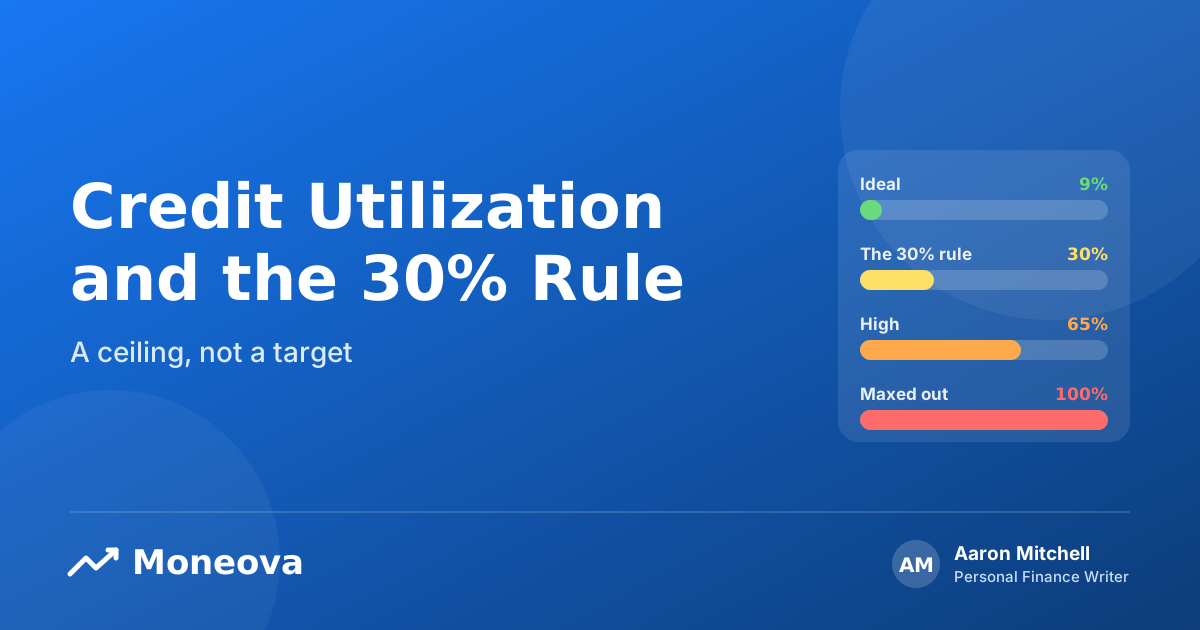
The 30 percent rule has been repeated so often that it now feels like a law of nature. It is not. It began as rough guidance, a rule of thumb meant to steer people away from the danger zone, and somewhere along the way it hardened into a target.
Here is what actually happens inside a scoring model. Utilization is treated as a continuous variable, not a switch. Your score does not sit unchanged at 29 percent and then fall off a cliff at 31 percent. It slides gradually. Someone reporting 8 percent will, all else equal, outscore someone reporting 28 percent. Both are under 30. One is doing far better.
So why does the number persist? Because it is a useful warning. Cross 30 percent and the negative effect becomes noticeably more pronounced. Below it, the damage is mild. That makes 30 a sensible line to avoid crossing. It makes it a terrible target to aim at, because aiming at it means accepting a score lower than the one you could have.
When people ask what should your credit utilization be, or what should my credit card utilization be, the 30 percent answer is not wrong so much as unambitious. The next section gives the number worth aiming for.
6. What a Good Credit Utilization Ratio Actually Is
So what is a good credit utilization ratio? If you want the short answer: aim for somewhere between 1 and 9 percent overall, with no single card above roughly 10 percent. That is what a good credit utilization ratio looks like in practice, and it is a long way below the familiar 30.
This is not a guess. Look at what people with the highest scores actually do. Data published by the credit bureaus shows a clean, unbroken pattern: the better the score band, the lower the reported utilization. People in the exceptional range are not sitting at 25 percent. They are sitting in the single digits.
| FICO Score Band | Rating | Typical Reported Utilization |
|---|---|---|
| 800 to 850 | Exceptional | Around 7% |
| 740 to 799 | Very good | Around 13% |
| 670 to 739 | Good | Around 35% |
| 580 to 669 | Fair | Around 57% |
| 300 to 579 | Poor | Around 80% |
Read that table from the bottom up and the story tells itself. Nobody climbs into the exceptional band while carrying half their available credit. And among people holding a perfect 850, the average utilization sits at roughly 4 percent. That is not a coincidence, and it is not a target anyone set for them. It is a by-product of using credit lightly.
So when you see phrases like best credit usage percentage, recommended credit utilization, or how much credit usage is good, the honest answer is: as low as you can manage while still using your cards. Aiming for a good credit utilization means aiming for single digits, not for 29 percent.
One caveat keeps this practical. Do not contort your life around a percentage. If you need to put a $900 repair on a card with a $1,500 limit, do it, pay it down, and let the number recover next month. Utilization has no long memory, which we cover in section 13.
7. Why 0% Utilization Is Not the Goal Either
Having pushed you toward the low single digits, here is the twist. Zero is worse than one.
It sounds absurd until you think about what a scoring model is trying to do. It is predicting whether you will repay borrowed money. If every one of your cards reports a $0 balance, the model has nothing recent to judge. You might be a careful spender. You might have shoved the cards in a drawer and forgotten them. The model cannot tell, and it does not reward the ambiguity.
This is why a 0 percent credit utilization can shave a few points off a score that would otherwise be higher. Not many points, and not enough to panic about, but the effect is real and it is consistent. The bureaus need to see that you use credit, and that you use it well.
The practical version: put one small recurring charge on one card, let it report, then pay it in full. A streaming subscription is perfect. You pay no interest, the account stays active, and the model sees exactly what it wants to see.
8. How Much Credit Utilization Affects Your Credit Score
Utilization is worth roughly 30 percent of a FICO score, second only to payment history at 35 percent. But asking how much does credit utilization affect credit score has a more interesting answer than that single figure suggests, because the effect is not the same for everyone.
8.1 The Higher Your Score, the More You Have to Lose
Someone with a score around 790 who maxes out a card can lose well over a hundred points. Someone with a score around 600 doing exactly the same thing might lose thirty or forty. The scoring model has already priced in the risk for the second person. For the first, a maxed card is new and alarming information.
The lesson runs against intuition. The better your credit, the more carefully you should watch your ratio. High scores are not armour. They are altitude, and there is further to fall.
8.2 Newer Models Watch the Trend, Not Just the Snapshot
Older scoring models only looked at your most recently reported balance. The newer ones, FICO 10 T and VantageScore 4.0, use what the industry calls trended data. They look at your balances over the past two years and notice whether you are steadily paying down or steadily creeping up.
For most people this changes very little. But it does mean a single clean month before a mortgage application carries less weight than it once did. Consistency is beginning to matter as much as the snapshot. The Federal Housing Finance Agency approved both models for conventional mortgage underwriting in April 2026, and FHA has since followed with its own approval; the rollout is staged rather than universal, so ask your specific lender which model they are using rather than assuming trended data applies to your application.
The federal Consumer Financial Protection Bureau puts the guidance plainly: keep your balances low compared to your total credit limit, and understand that you do not need to carry a balance to build a good score. Those two sentences quietly dismantle most of the folk wisdom on this subject.
9. A Real Example: How Utilization Moved One Score
Numbers make this concrete. Meet Priya, 31, a graphic designer with two credit cards and a solid payment record. She has never missed a payment in six years. Her score sits at 704, which is good but not where she wants it, because she is applying for a mortgage in five months.
9.1 Where Priya Starts
Priya has a $6,000 limit across two cards and carries $2,700 in balances, mostly from a laptop she bought last year. That is 45 percent utilization. She pays well above the minimum every month and assumed her spotless payment history was doing all the work.
Her mistake is a common one. She was treating utilization as a side issue rather than as the single largest thing standing between her and a better mortgage rate.
9.2 What She Changes and What Happens
She does three things. She stops adding new charges to the cards. She pays $500 a month against the balance instead of $180. And she calls the issuer of her older card and asks for a credit limit increase, which is granted without a hard inquiry, raising her total limit to $7,500.
The table below tracks her ratio and her score. The scores are illustrative, since every credit file behaves differently, but the shape of the curve is what matters.
| Month | Total Balance | Total Limit | Utilization | Score |
|---|---|---|---|---|
| Start | $2,700 | $6,000 | 45% | 704 |
| Month 1 | $2,200 | $7,500 | 29% | 719 |
| Month 2 | $1,700 | $7,500 | 23% | 728 |
| Month 3 | $1,200 | $7,500 | 16% | 741 |
| Month 4 | $700 | $7,500 | 9% | 756 |
| Month 5 | $300 | $7,500 | 4% | 763 |
Three things stand out. Her payment history did not change at all across those five months, yet her score rose 59 points, which tells you where the weight sits. The limit increase alone dropped her ratio from 45 to 36 percent before she paid a single extra dollar. And she never reached zero, deliberately leaving $300 reported so the model could see active, controlled usage.
On a $300,000 mortgage, moving from 704 to 763 could reasonably shift her rate by half a percentage point or more. Over thirty years, that is tens of thousands of dollars, earned by changing one number.
10. Why Utilization Hurts More Than Your App Suggests
Everything above assumes one score. You have dozens, and utilization is the single factor where they disagree most. This matters because the free app most people watch is systematically more forgiving about utilization than the score a lender actually uses.
Here is the weighting difference, and it is not small:
| Factor | FICO 8 (what about 90% of lenders use) | VantageScore 3.0 (what Credit Karma shows) |
|---|---|---|
| Amounts owed / utilization | About 30% | About 20% |
| Payment history | About 35% | About 40% |
| Per-card balances | Weighed individually and hard | More forgiving if total utilization is low |
Read the first row. Mortgage FICO puts roughly 30% of your score on amounts owed; VantageScore puts about 20%. In practice that means a 45% utilization ratio can drop your mortgage FICO by 40 to 60 points while barely denting the number on your phone. You can be watching a comfortable score, feel fine about your balances, and walk into an application to find the lender seeing something materially worse.
The per-card row matters just as much for anyone carrying one maxed card. VantageScore is relatively forgiving of a single high balance if your overall utilization is low. FICO is not. So the classic situation, one card at 90% and three others empty, looks acceptable on Credit Karma and considerably worse to a lender.
None of this changes what you should do. It changes how confident you should be that you have already done it:
- Do not use your app's score to judge whether your utilization is fine. It is measuring the same balances with a formula that cares less. A number that looks healthy there can still be costing you 40 to 60 points where it counts.
- Fix the per-card ratio, not just the overall one. This is where the two models diverge most, and FICO, the one lenders use, is the strict one.
- Timing beats everything, on both models. Both read whatever balance your issuer reported on the statement date. Paying before that date lowers the reported figure on every model at once, which is the one action that helps regardless of which score gets pulled.
- Before a mortgage, assume the strict version. Mortgage lenders use FICO 2, 4 and 5, older models that are less forgiving than either FICO 8 or VantageScore. If you are within six months of applying, treat your utilization as though it matters more than your app says, because it does.
The reassuring half: the direction always agrees. Lowering utilization improves every model. You just cannot rely on the free number to tell you how much room you still have.
Model weightings are the published FICO 8 and VantageScore 3.0 category weights. Point estimates are illustrative: no scoring model publishes an exact points-per-percent formula, and your own impact depends on your full credit file. Use this to understand direction and relative severity, not to predict a number. Last checked July 2026.
11. When Your Balance Gets Reported to the Bureaus
This is the section that surprises people most, and it explains a puzzle that frustrates careful spenders everywhere.
Your card issuer reports one balance to the credit bureaus each month. It reports the balance on your statement closing date, not the balance after you pay. Those are two different days, usually about three weeks apart.
So imagine you charge $1,400 to a card with a $2,000 limit, then pay the full $1,400 before the due date and never touch a cent of interest. You have behaved perfectly. But if that $1,400 was sitting there when the statement closed, the bureaus were told you were using 70 percent of your limit. Your careful payment came too late to change what was reported.
| Date | What Happens | What the Bureau Sees |
|---|---|---|
| 1st to 20th | You charge $1,400 | Nothing yet |
| 21st (statement closes) | Balance is $1,400 | 70% utilization reported |
| 15th of next month (due date) | You pay $1,400 in full | Already reported. Too late. |
The fix is straightforward once you know it. Find your statement closing date, which is printed on every statement, and pay most of the balance down a few days before it. Leave a small amount so you are not reporting zero. Your utilization drops immediately, and you still pay no interest.
People sometimes ask how often is credit utilization reported. Once per card, per billing cycle, in most cases. The same rhythm governs your whole file, and our guide to how often your credit score updates walks through the full reporting chain. That means a single well timed payment each month is enough. You do not need to obsess over it daily.
12. Does Credit Utilization Matter If You Pay in Full?
Yes, and section 10 explains exactly why. This is probably the single most common misunderstanding about the whole subject.
Paying in full protects you from interest. It does not protect you from a high reported utilization, because the report is taken before your payment lands. Two people can both pay in full every month and end up with very different ratios on their credit file, purely because of when they spend relative to their statement date.
Here is the reassuring half. Paying in full is still absolutely the right habit, and you never need to carry a balance to build credit. That myth costs people real money in interest for no scoring benefit whatsoever. The CFPB says so directly. What you need is not debt. It is a low balance on the day the statement closes.
13. What High Credit Utilization Signals to a Lender
High credit utilization is not a moral failing, and lenders do not read it as one. They read it as pressure. Someone using most of their available credit has less room to absorb a surprise, and surprises are what lenders are pricing. This is a different signal from, but often reviewed alongside, your debt to income ratio, the other number lenders lean on heavily.
The consequences show up in ways beyond the score itself.
- Higher interest rates. A lender that sees a stretched borrower prices the risk into the rate you are offered on a card, a car loan, or a mortgage.
- Lower approval odds. Some issuers decline applications outright when utilization crosses their internal threshold, regardless of a clean payment record.
- Reduced credit limits. An existing issuer can cut your limit on a card you already hold, which perversely pushes your utilization higher still.
- A harder mortgage process. Underwriters look closely at revolving balances. A high utilization credit card can complicate an approval even when your income comfortably supports the loan.
At the extreme, 100 percent credit utilization means a maxed out credit card, and the scoring damage is severe. If that is where you are, the good news is that this is the fastest factor to repair. It responds within one or two billing cycles, which is not true of a late payment.
If the balances have grown beyond what you can pay down in a few months, it may be worth reading our guide to debt consolidation, which explains how moving revolving balances into an installment loan can lower both your interest cost and, because installment loans sit outside the calculation, your utilization at the same time.
14. How to Lower Your Credit Utilization
If you have been searching for how to lower credit utilization, the answer is refreshingly short. There are only two ways to move the ratio: shrink the top of the fraction, or grow the bottom. Everything below is a version of one of those.
- Pay down before the statement closes. The highest leverage action available, and it costs nothing. Find the closing date, pay most of the balance a few days early, leave a small amount reporting.
- Make more than one payment a month. Paying every two weeks keeps the running balance lower, so whatever gets reported is smaller.
- Ask for a credit limit increase. A larger denominator lowers the ratio without you paying a cent. Ask whether the issuer will do it with a soft pull, since some will, and only accept if you are confident you will not spend into the new headroom.
- Keep old cards open. Closing a card destroys its limit and raises your ratio instantly. If the card charges no annual fee, leave it open and put one small charge on it occasionally.
- Spread balances across cards. Two cards at 20 percent look better than one at 5 percent and one at 90 percent, because per-card utilization is visible to the model.
- Move revolving debt to an installment loan. A personal loan or balance transfer converts revolving debt into installment debt, which leaves the utilization calculation entirely.
The most encouraging fact about lowering credit utilization is that it has no memory. The scoring model recalculates from the most recently reported balances. A terrible ratio in March does not haunt you in June if June's numbers are clean. Nothing else in credit scoring forgives you that quickly.
If you are still building your first accounts, our guide on how to build credit from scratch covers the accounts that give you a credit limit in the first place, which is where any utilization strategy has to begin.
15. Common Mistakes That Raise Your Ratio
- Closing your oldest credit card. You lose its limit, your total available credit shrinks, and every balance you still carry now represents a bigger share of a smaller number.
- Believing you must carry a balance. You do not. Carrying a balance raises your reported utilization and costs you interest. It buys you nothing.
- Checking your ratio only before applying for credit. With trended data in the newer models, a single tidy month is worth less than it used to be. Consistency counts.
- Letting one card sit near its limit. A comfortable overall figure does not hide a card at 95 percent from a model that reads per-card utilization.
- Chasing exactly 30 percent. It is a ceiling, not a goal. Aiming at it means settling for a lower score than you could have.
- Reporting zero on everything. A tiny reported balance beats none at all, because the model needs something to read.
You can see the raw numbers behind your own ratio for free. Pull your reports from all three bureaus at AnnualCreditReport.com, the only federally authorised site for this, and check the reported balance and limit on every revolving account. Checking your own report is a soft inquiry and never lowers your score.
16. Frequently Asked Questions
17. Final Thoughts
Credit utilization rewards attention more generously than almost anything else in personal finance. Payment history takes years to build. The average age of your accounts cannot be rushed. But your credit utilization ratio can improve within a single billing cycle, using money you were going to spend anyway.
Forget 30 percent as a target. Treat it as the edge of a cliff, stay well back from it, and aim instead for the single digits that people with excellent scores quietly maintain. Find your statement closing date. Pay down before it. Keep your oldest card open. Never let one card sit near its limit. And do not report zero across the board, because the model needs to see you using credit well, not avoiding it entirely.
Do those five things and the number takes care of itself. It is the rare corner of credit where a small, informed change produces a visible result inside a month.
This article is for general information only and is not financial advice. The score movements in the example are illustrative and are not a promise of results. Always confirm reporting dates with your own card issuer. Please read our full Disclaimer.