 Insurance
Homeowners Insurance Explained: What's Covered (and What Isn't)
Most people think of homeowners insurance as one single promise: if something bad happens to your house, you're covered. In practice it's several different, narrower promises bundled into one policy, and the fine print on each one is what actually decides whether a claim gets paid.
This article covers the open perils versus named perils split that applies differently to your house than to your belongings, the sublimits that quietly cap "full" coverage, a real coverage gap for manufactured homes, and the 30-day rule that can end coverage on an empty house nobody remembered to check.
1. What Homeowners Insurance Actually Is
Homeowners insurance is a package deal, not one single protection. The standard policy most people buy, a homeowners insurance policy known in the industry as an HO-3, bundles together several genuinely different coverages under one premium.
USA.gov's overview of homeowners insurance describes it as personal liability home insurance protection for your home's structure, your belongings, and your financial liability if someone gets hurt on your property, all in one policy.
Most mortgage lenders require at least this level of coverage as a condition of the loan, and home insurance mortgage requirements typically stay in place for as long as the loan does, whether you realize it's a requirement or just assume it's optional.
What trips people up isn't any single piece of that bundle. It's that the pieces don't all work the same way, even within one policy.
2. Homeowners Insurance: The Split Most Guides Skip, Open Perils vs Named Perils
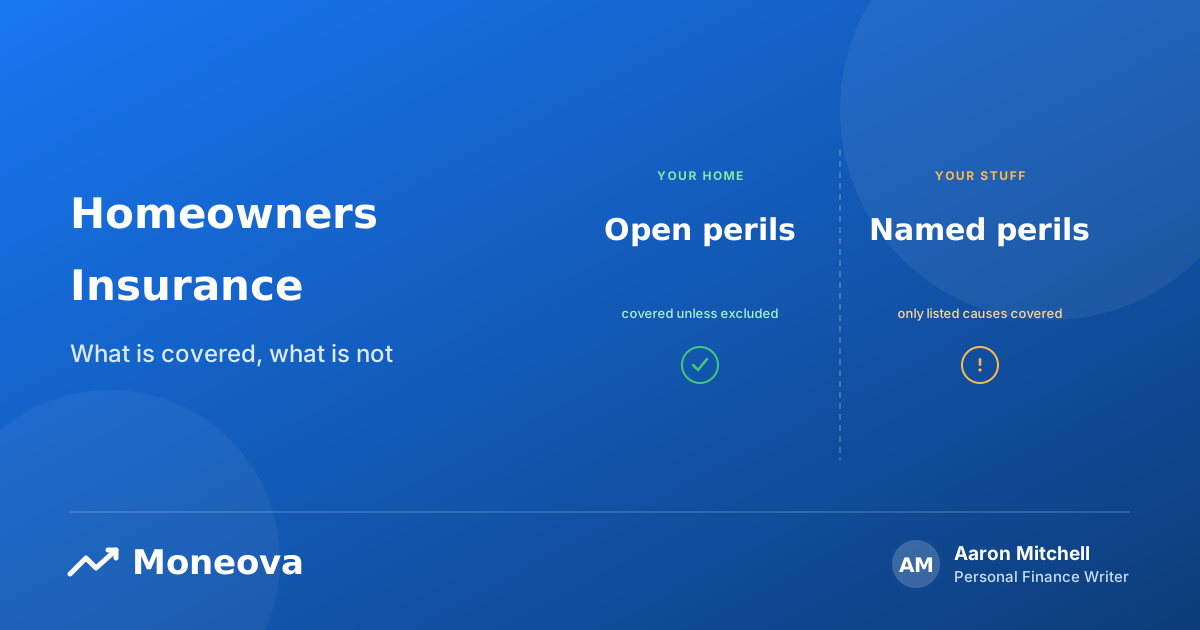
Home insurance dwelling coverage and personal property coverage follow different rules, and this is the mechanic that actually determines what a claim looks like, one most explanations gloss right over.
| Your home's structure | Your personal belongings | |
|---|---|---|
| Coverage basis | Open perils | Named perils |
| What that means | Covered for everything except what's specifically excluded | Covered only for causes specifically listed in the policy |
| Burden of proof | You just need to show the cause wasn't an exclusion | You need to show the cause matches a named peril |
Open perils is the broader, more forgiving standard. If something damages your house and the cause isn't on the exclusion list, you're covered, full stop. Named perils is narrower. Your furniture, electronics, and clothes are only protected against causes the policy actually lists, typically things like fire, theft, windstorm, and a defined set of others.
Two people can file claims for the same storm and get different answers depending on which part of the policy is doing the covering. Wind tears off part of your roof: structure claim, open perils, almost certainly covered. That same wind blows a tree branch through a window and ruins a rug: personal property claim, named perils, covered only if the specific cause matches something on the list.
3. Find Your Real Homeowners Insurance Coverage Gap on High-Value Items
Enter what a category of belongings is actually worth, and see the standard sublimit most policies cap it at.
Pick a category and enter what it's actually worth to see the standard sublimit gap.
Illustrative only, not insurance advice. Sublimits vary by carrier and state; confirm your specific policy's limits directly. Sources read 29 August 2026.
4. The Homeowners Insurance Sublimit Trap: Why "Fully Covered" Often Isn't
Even within named perils personal property coverage, certain categories get capped far below your overall policy limit, and most people never find out until they file a claim.
| Category | Typical sublimit |
|---|---|
| Cash, money, coins | $200 |
| Jewelry, watches, furs (theft) | $1,500 |
| Firearms | $2,500 |
| Silverware | $2,500 |
Here's the trap: your overall personal property limit might be $50,000, which sounds like more than enough. If $5,000 in jewelry gets stolen, you still only collect $1,500, the sublimit, not the $50,000 headline number. The gap doesn't disappear just because your total coverage looks generous.
An endorsement, sometimes called a rider or a scheduled item, raises the limit for a specific category or a specific item. A single valuable piece, like an engagement ring, usually needs its own scheduled endorsement and its own appraisal, not just a bump to the general jewelry sublimit.
5. Homeowners Insurance: Actual Cash Value vs Replacement Cost, the Second Hidden Split
Even after you clear the named-perils hurdle for a personal property claim, one more distinction decides how much you actually get paid.
A standard HO-3 policy typically pays personal property claims at actual cash value, meaning your five-year-old television gets valued at what a five-year-old television is worth today, depreciation included, not what a new one costs to replace. An HO-5 policy, one tier up, commonly pays personal property at full replacement cost instead, with no depreciation subtracted.
Dwelling coverage has its own version of this same gap. A standard HO-3 pays up to your policy's stated limit, not automatically whatever it costs to actually rebuild. If construction costs rise and your coverage limit doesn't keep pace, you can end up underinsured on the exact day you need the payout most, even though nothing about your policy technically lapsed.
Many policies also require you to insure the dwelling to at least 80% of its replacement value to get full replacement-cost payouts at all; fall below that threshold and even a partial claim can get penalized proportionally, not just a total loss.
6. What Homeowners Insurance Actually Excludes
The exclusion list matters as much as the coverage list, and two exclusions in particular catch people by surprise.
- Flood and earthquake, almost universally. These sit outside standard homeowners coverage entirely, regardless of carrier. FEMA's National Flood Insurance Program page covers the separate federal flood insurance program; earthquake coverage is typically its own separate policy or endorsement.
- Wear and tear, neglect, and gradual damage. Insurance covers sudden, accidental events. A roof that fails from age, not a storm, generally isn't a covered claim.
- Government action and building code enforcement. If a covered loss triggers a requirement to rebuild to a newer code standard, the extra cost of meeting that code often isn't included unless you've added ordinance-or-law coverage specifically.
- Intentional acts and pest damage. Neither is a "cause" the policy is designed to cover.
- Business equipment and business liability, mostly. A standard policy caps business property coverage at a few thousand dollars and often excludes business liability entirely. Working from home insurance needs, like client visits or expensive equipment, usually require a separate rider or a dedicated home-business policy, not just the base coverage. If you're weighing whether to rent or buy in the first place, our investing basics guide covers how homeownership fits into a broader financial plan.
7. Manufactured and Mobile Home Insurance: A Real Coverage Gap
Not every standard homeowners insurer even writes mobile home insurance or manufactured home insurance policies. This is a genuine, structural gap, not a minor detail.
Many large carriers simply don't offer manufactured home coverage at all, which means shopping specifically for an insurer that specializes in mobile and manufactured homes, rather than assuming your regular homeowners insurer will extend the same policy to a different structure type. Specialist carriers exist precisely because of this gap, and they're often the only realistic option for older manufactured homes or unusual situations a large carrier would simply decline.
Coverage itself, once you find the right carrier, looks similar to standard homeowners insurance: the structure, personal belongings, liability, and temporary living expenses. The same flood, earthquake, and wear-and-tear exclusions apply here too.
8. Vacant Home Insurance: The 30-Day Rule Almost Nobody Knows About
Leave a home empty long enough, and standard coverage can quietly stop applying, before you've done anything else wrong.
Many standard homeowners policies stop covering a property once it's been vacant for 30 to 60 days. This catches people off guard constantly: an inherited house between the funeral and the sale, a home between tenants, an extended hospital stay, a long deployment. Nobody cancels the policy, the premium keeps getting paid, and the coverage still quietly stops working.
Vacant and unoccupied aren't the same thing, and the distinction changes what applies. Vacant generally means the home has little or no furniture or belongings left inside.
Unoccupied means it's still furnished but nobody's living there right now, which typically comes with fewer restrictions and a smaller premium increase than true vacancy. If a property is going to sit empty past that 30 to 60 day window, a dedicated vacant home insurance policy is usually the only way to keep real coverage in place.
9. Homeowners Insurance Policy Codes: What the Other Numbers Mean
HO-3 dominates the market, but it's not the only code you'll run into while shopping, and knowing what the others mean helps you spot when you're being offered something weaker or stronger than you expected.
- HO-1 and HO-2 (basic and broad form). Both are named perils for the dwelling too, not just personal property, making them more restrictive than HO-3. HO-1 is rare and often doesn't satisfy mortgage lender requirements at all; HO-2 covers a broader list of named perils but still requires you to prove the cause matches the list.
- HO-5 (comprehensive form). The upgrade from HO-3: open perils coverage extends to personal property too, not just the dwelling, and typically pairs with replacement cost rather than actual cash value. Costs more, and isn't offered by every carrier for every home.
- HO-4 (renters) and HO-6 (condo). Neither includes dwelling coverage, since someone else, a landlord or a condo association, is responsible for the structure itself. Both focus on personal property, liability, and loss of use.
- HO-7 and HO-8. HO-7 is the mobile and manufactured home equivalent of an HO-3. HO-8 is built for older homes where replacement cost would badly exceed market value, paying claims differently to reflect that gap.
If an agent quotes you something other than HO-3 or HO-5 for a standard single-family home, it's worth asking directly why, since it's often a sign of a more limited, named-perils dwelling policy being offered at a lower premium.
10. A Real Homeowners Insurance Example: Same Storm, Two Different Outcomes
A windstorm hits Maria's and Tom's neighborhood on the same night. Both have standard HO-3 policies with a $50,000 personal property limit.
| Maria | Tom | |
|---|---|---|
| What happened | Wind tears shingles off the roof | A branch shatters a window, ruining a rug and a laptop inside |
| Which coverage applies | Dwelling, open perils | Personal property, named perils |
| Proof required | Just that wind caused it, not an exclusion | That "windstorm" is a named peril in the policy (it usually is) |
| Outcome | Covered, straightforward claim | Covered, but only because windstorm happens to be on the named list |
Both claims got paid here, but for structurally different reasons, and the same logic applies whether it's a standalone house or condo home insurance covering a unit. If Tom's laptop had been damaged by something not on the named perils list instead, a burst pipe from a slow, undetected leak for example, his claim could have gone very differently even though the dollar amount was similar.
11. Frequently Asked Questions
12. Final Thoughts
Homeowners insurance isn't one uniform promise. It's several different promises bundled into one policy, each with its own rules for what counts as covered and how much you actually get paid. The open perils versus named perils split alone explains more claim outcomes than most people realize going in.
Before you assume a policy has you covered, check three things specifically: whether the coverage in question is open or named perils, whether a sublimit applies to anything valuable you own, and whether the property will ever sit vacant long enough to matter. Those three questions catch more real coverage gaps than reading the declarations page cover to cover.
If you're shopping for a mortgage alongside a policy, our FHA vs conventional loan guide covers how lender requirements and insurance requirements often overlap.
This article is for general information only and is not insurance advice. Coverage details, sublimits, and exclusions vary significantly by carrier, state, and specific policy, and were current as of 29 August 2026. Confirm your specific policy's terms directly with your insurer or agent before making a decision. Figures in examples are illustrative, not guarantees of any specific outcome.Disclaimer.