 Investing
How to File a Tax Extension: What It Does and Doesn't Cover
Every April, millions of people file a tax extension and breathe a sigh of relief, thinking the whole problem is solved for six months. For anyone who owes money, that relief is only half deserved.
This article covers exactly what Form 4868 does and doesn't cover, the penalty math most explanations get slightly wrong, the three safe harbor rules that protect you from underpayment penalties, and the handful of deadlines that don't move no matter what.
1. What a Tax Extension Actually Does
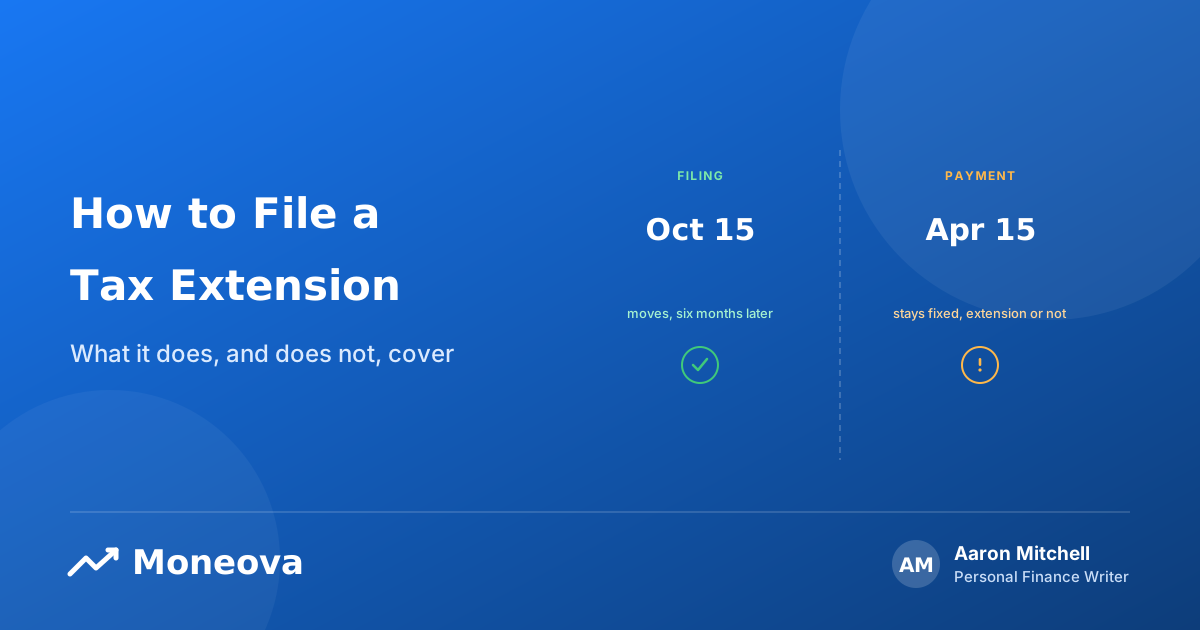
Filing Form 4868 is how you extend tax deadline pressure by six months, moving it off you in April. It buys you six more months to file your federal return. That's it. It moves your paperwork deadline from April 15 to October 15.
It does not move your payment deadline. the IRS's own newsroom page on requesting an extension_LINK states this directly: an extension provides extra time to file, not additional time to pay. Whatever you owe is still due April 15, extension or not.
This single distinction causes more expensive mistakes than almost anything else in the tax code. People file the extension, feel like they've bought themselves breathing room, and then get hit with penalties and interest on money that was due months earlier. If the shortfall involves investment income, our capital gains tax guide covers how that gets calculated in the first place.
2. Who Actually Benefits From a Tax Extension
Filing an irs tax form 4868 extension is genuinely useful in specific situations, not a default move everyone needs.
- You're waiting on tax documents. A late K-1 from a partnership, a corrected 1099, or any form that hasn't arrived yet is a legitimate reason to want more time.
- Your return is unusually complex. A home sale, a business sale, an inheritance, or any major life event that touches your taxes often benefits from more time to get the numbers right rather than rushing.
- You have the money but not the paperwork. If you can pay your estimated liability by April 15 but need more time to actually assemble the return, an extension solves exactly that problem.
What an extension does not solve is not having the money. If you owe taxes and simply can't pay, filing Form 4868 buys you time on the paperwork, but the payment obligation and its penalties keep running regardless. In that situation, paying what you can by April 15 and setting up an IRS payment plan for the rest is the more useful move.
3. How to Actually File a Tax Extension
Every method below is a legitimate Internal Revenue Service extension request, free, and the deadline is the same regardless of which you use.
- IRS Free File. Go to IRS.gov and file Form 4868 electronically, at no cost, regardless of your income. This is worth noting specifically: Free File's full tax-return preparation service has an income limit, but the extension-only filing does not. Anyone can use it for Form 4868, whatever their income. You get instant confirmation it was accepted.
- Make a payment marked "extension." Pay through IRS Direct Pay, EFTPS, or a debit or credit card, and select the payment reason as an extension. The IRS treats this as a filed extension automatically. No separate form needed at all.
- Mail the paper form. Download Form 4868 from IRS.gov and mail it, postmarked by April 15. Slowest option, and you get no confirmation receipt, so electronic filing is safer if you have the choice.
There's no grace period on the deadline itself. The tax extension form itself, the IRS's official page for Form 4868_LINK, confirms Form 4868 has to be filed or postmarked by the original due date. A day late means no extension at all, only a return that's now officially late.
4. Work Out What Missing the Deadline Actually Costs
Enter what you owe, how many months late you are, and whether you filed an extension, and this shows the real penalty math, not just "you'll owe more."
Enter what you owe, how many months late you are, and whether you filed an extension.
Illustrative only, not tax advice. Interest estimated at roughly 7% annually, simple, not compounded; the IRS sets the actual rate quarterly. Sources read 19 August 2026.
5. Tax Extension Penalty Math Almost Nobody Explains Correctly
Two separate penalties can apply, and most explanations treat them as simply additive, which overstates the cost.
| Penalty | Rate | Cap | Avoided by filing Form 4868? |
|---|---|---|---|
| Failure-to-file | 5% of unpaid tax per month | 25% | Yes |
| Failure-to-pay | 0.5% of unpaid tax per month | 25% | No |
Here's the part that surprises people: when both penalties apply in the same month, the failure-to-file rate doesn't simply stack on top of the failure-to-pay rate. It gets reduced by 0.5 points, to 4.5% a month, so the combined rate for the first five months is 5% total, not 5.5%.
After five months, the failure-to-file penalty has effectively run its course. From there, only the failure-to-pay penalty continues, at 0.5% a month, until it also reaches its own 25% cap. The maximum combined exposure works out to 47.5% of the unpaid tax, plus interest that keeps accruing with no cap at all.
Interest is the part people underestimate most. It runs at the federal short-term rate plus 3 percentage points, reset every quarter, and it compounds daily rather than sitting flat like the penalties do. There is no cap on interest at all; it keeps accruing for as long as the balance goes unpaid, even after both penalties have maxed out.
Your extension itself can also be invalidated in one specific way: if the estimate on Form 4868 turns out to have been unreasonable, not just wrong, but not made in good faith, the IRS can treat the extension as if it was never filed. A number that turns out to be off is fine. A number picked with no real attempt to estimate accurately is not.
6. Tax Extension Safe Harbor Rules: How Much You Actually Need to Pay
Filing the extension is only half the job. The IRS also expects a reasonable payment estimate by April 15, and there are three ways to satisfy that requirement without guessing exactly right.
- Owe less than $1,000. After withholding and credits, if your remaining balance is under $1,000, no underpayment penalty applies at all.
- Pay 90% of this year's actual liability. If your total payments by April 15 cover at least 90% of what you'll ultimately owe for the year, you're covered.
- Pay 100% of last year's liability. Or 110% if your prior-year income was above $150,000. This is the most reliable option, since it uses a known number instead of a projection: check line 24 of last year's return and make sure this year's withholding plus any extension payment reaches that figure.
Meeting any one of these three tests avoids the underpayment penalty, even if your final tax bill turns out higher than expected.
7. Tax Extension Special Situations: Abroad, Combat Zones, Disasters
A few groups get more time automatically, sometimes without filing anything.
- Living abroad. US citizens and residents outside the country on April 15 get an automatic two-month extension to June 15, no form required. Interest still accrues on unpaid tax from April 15 though; this only extends filing. From there, filing Form 4868 by June 15 adds the standard extension to October 15.
- Military in a combat zone. This is the one real exception to "extensions never cover payment." Service members in a designated combat zone get an extension running until 180 days after leaving the zone, and it extends both filing and payment. Penalties and interest are suspended for the whole period.
- Federally declared disaster areas. The IRS typically grants automatic filing and payment extensions based on the address on file, no application needed. This is the second exception, alongside combat zones, where an extension actually does cover payment, not just filing. Current relief is listed on IRS.gov's disaster relief page, and it changes throughout the year as new disasters get declared, so checking your specific county matters more than assuming last year's list still applies.
8. What an Extension Does Not Touch
A few deadlines people assume move with the tax deadline actually don't.
- Traditional and Roth IRA contributions for the tax year stay fixed at April 15, extension or not. A SEP-IRA is the one exception: self-employed filers can fund a SEP-IRA up to the extended October 15 deadline.
- State tax deadlines often don't follow the federal extension automatically. Some states accept the federal Form 4868 with no separate filing; others require their own extension form entirely. USA.gov's overview of federal tax return extensions_LINK recommends checking your specific state before assuming you're covered.
- Estimated tax payments keep running on their own quarterly schedule, independent of any extension you've filed for the prior year's return.
9. How Common a Tax Extension Is, and What Happens If You Miss Both Deadlines
More than 20 million Americans file tax extension requests each year, roughly one in seven individual filers, based on 2024 IRS data. This is routine, not a red flag; the IRS has stated directly that filing Form 4868 does not affect audit selection.
Missing the extension deadline entirely is a different situation. If you filed Form 4868 in April and still miss the October 15 date, the failure-to-file penalty starts applying from October 16, the same 5% monthly rate as if you'd never filed anything at all.
- First-time penalty abatement can waive the failure-to-file or failure-to-pay penalty for taxpayers with a clean compliance history over the prior three years. You have to file the return first; the IRS won't abate a penalty on a return that's still unfiled.
- California automatically grants a state filing extension if you don't owe state tax, no form needed. If you do owe, you'll need Form FTB 3519 to make the payment.
- New York grants an automatic extension if you file the federal Form 4868 and don't owe state tax. Owing New York tax generally means filing a separate state extension form.
Every state runs its own rules, and they change. Confirming your specific state's current requirement takes a few minutes and avoids a second, entirely separate penalty running alongside the federal one. If part of what you owe involves losses you could have used to offset gains, our tax loss harvesting guide covers that strategy for next year.
10. A Real Example: Same Extension, Different Bills
Sarah and Tom each file irs form 4868 by April 15, owing $6,000 apiece. Sarah pays the full $6,000 with her extension. Tom pays nothing, planning to settle up when he files in September.
| Sarah | Tom | |
|---|---|---|
| Paid with extension | $6,000 | $0 |
| Failure-to-file penalty | None, extension filed | None, extension filed |
| Failure-to-pay penalty (5 months) | $0 | $150 (0.5% x 5 x $6,000) |
| Interest (5 months, ~7% annually) | $0 | ~$175 |
| Total extra cost | $0 | ~$325 |
Both filed the exact same form on the exact same day. The only difference was whether Tom's estimate came with a check attached. Filing the extension protected both of them from the much larger failure-to-file penalty; only paying protected Sarah from the rest.
A close but accurate estimate costs far less than either extreme. Someone who estimates $8,500, pays $8,000 with their extension, and finds their actual liability is $8,300 when they file in September owes $300 plus a few months of failure-to-pay penalty and interest on just that shortfall, often under $10 total. The size of the mistake, not just its existence, is what determines the cost.
11. Frequently Asked Questions
12. Final Thoughts
A tax extension is a genuinely useful tool, and also a genuinely easy one to misunderstand in a way that costs real money. Filing Form 4868 protects you from the expensive failure-to-file penalty. It does nothing about the smaller, still-real failure-to-pay penalty and interest on whatever you owe.
If you're not sure exactly what you'll owe, the safe harbor rules give you three separate ways to be covered without guessing perfectly. Paying something, even an imperfect estimate, by April 15 is almost always better than paying nothing and hoping October works out.
This article is for general information only and is not tax or financial advice. Rules and figures described here reflect IRS.gov and IRS Topic No. 306, read 19 August 2026. Penalty rates, deadlines, and interest rates can change; confirm current figures and your specific situation with a qualified tax professional before acting. State extension rules vary significantly and are not covered by the federal information here. Figures in examples are illustrative, not guarantees of any specific outcome.Disclaimer.