 Loans
Loans
Loan Amortization Explained: How Your Payments Actually Work
Open a mortgage statement after a year of payments and the balance has barely moved, even though every payment has been on time. That is not a mistake and it is not you being charged unfairly. It is amortization, the standard structure behind almost every fixed-payment loan, and it front-loads interest so heavily that early payments do more to satisfy the lender than to build your equity.
This article covers exactly why that happens, the formula behind it, and the point roughly halfway through a mortgage where the split finally flips toward principal. It also covers what extra payments really do to the schedule, why the same extra dollar is worth far more early in a loan than late, and negative amortization: the reverse of all this, where the balance grows instead of shrinks, and where it shows up in products most guides never mention.
1. What Amortization Actually Means
Amortization is the process of paying off a loan through a series of fixed payments, where each payment covers the interest that has built up since the last one, plus a portion of the amount you originally borrowed. Set it up correctly, called fully amortizing, and the balance reaches exactly zero on the final scheduled payment.
The mechanic that surprises almost everyone: your payment amount stays the same every month on a fixed-rate loan, but what that payment actually buys changes completely over the life of the loan.
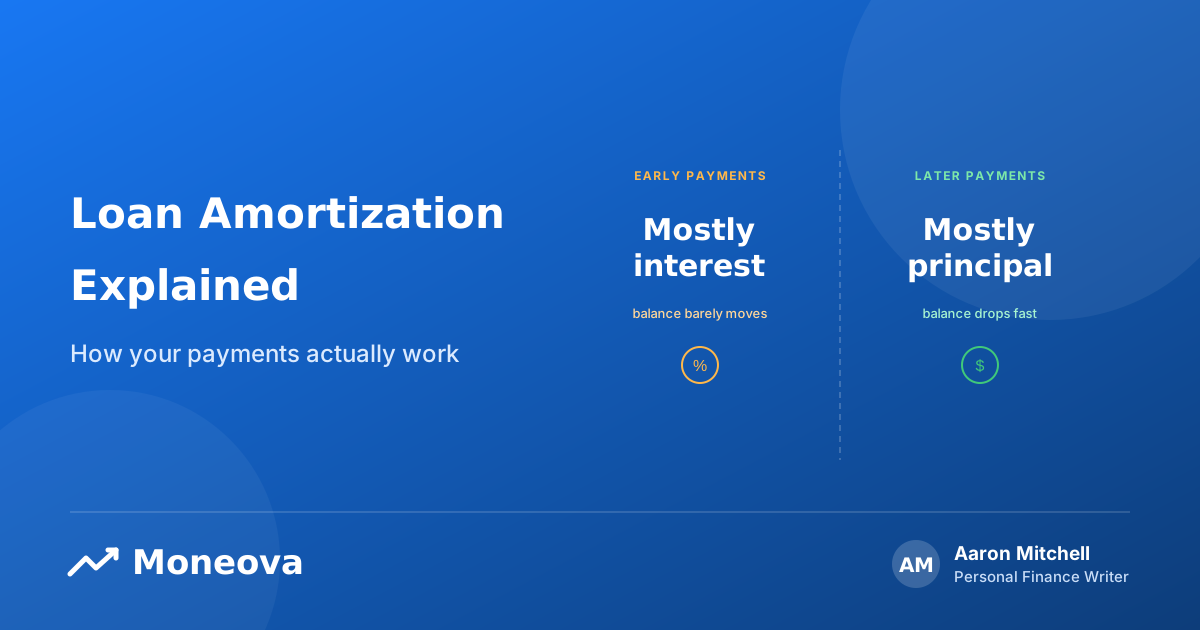
- Early payments are mostly interest. On a typical 30-year mortgage, as much as 80 to 85 percent of your first few years of payments goes to interest, not principal.
- That ratio flips gradually, not suddenly. Around year 18 to 20 of a 30-year loan, the split reaches roughly 50/50 between interest and principal.
- By the final years, almost the entire payment goes to principal. The last payment might be $15 of interest and the rest principal, on a payment that started out mostly interest.
- It applies to more than mortgages. Auto loans, personal loans and student loans all use the same front-loaded structure, just compressed into shorter terms.
2. Why Your Balance Barely Moves at First
This is the part that catches people off guard on a real mortgage statement: paying $2,000 a month and watching the balance drop by only a few hundred dollars.
The reason is simple once you see it. Each month, the interest charge is calculated as your outstanding balance multiplied by the monthly interest rate. Early in the loan, that balance is the full amount you borrowed, so the interest charge is at its largest. Whatever is left of your payment after covering that interest goes to principal, which is why the principal portion starts small.
| Year of a 30-year, $350,000 loan at 6.5% | Roughly to interest | Roughly to principal |
|---|---|---|
| Year 1 | ~85% | ~15% |
| Year 10 | ~65% | ~35% |
| Year 19 (the crossover) | ~50% | ~50% |
| Year 30 (final payments) | ~2% | ~98% |
As each payment chips away at the balance, next month's interest charge is calculated on a slightly smaller number, so a slightly larger share of the next payment goes to principal. The shift is gradual and compounding, which is also exactly why extra payments made early in a loan are so much more powerful than the same extra payment made later, covered in section 5.
3. What Decides Your Payment Amount
An amortization chart makes this easier to see at a glance than a table of numbers. You do not need to calculate this by hand, and the calculator in the next section does the real work, but it helps to know what actually decides the number.
Your fixed payment is set by three things only: how much you borrowed, your interest rate, and how many payments you will make. Change any one and the payment changes with it.
| Example: $300,000 borrowed at 6.5% | 25-year term | 30-year term |
|---|---|---|
| Fixed monthly payment | $2,026 | $1,896 |
| Total interest paid | $307,686 | $382,633 |
| Difference from the 30-year loan | $130 a month more | $74,947 more interest |
Five extra years on the term drops the monthly payment by $130, and costs an extra $74,947 in interest over the life of the loan. Neither number is arbitrary: both come from the same underlying calculation, the mortgage amortization formula, that finds the one fixed payment which reduces a given balance to exactly zero over a given number of months at a given rate. Put your own loan amount, rate and term into the calculator below rather than working through the algebra by hand.
One detail worth flagging regardless of term: this calculation covers only principal and interest. If you have an escrow account for property taxes and homeowners insurance, your actual monthly payment is higher than the number above, and that portion never appears on the amortization schedule itself because it is not part of paying down the loan.
4. Build Your Own Amortization Schedule
Use this amortization schedule calculator, or loan amortization calculator, to work it out precisely. Enter your loan amount, rate and term below. This works out your fixed monthly payment, shows how much of your first payment goes to interest versus principal, finds the approximate year your split crosses 50/50, and calculates the total interest you would pay over the full term.
Enter your loan amount, annual interest rate and term. This calculates your fixed monthly payment, breaks down how much of your first payment is interest versus principal, estimates the year your split reaches roughly 50/50, and totals the interest you would pay over the full term.
Illustrative only, not financial advice. Assumes a standard fully amortizing, fixed-rate loan with monthly payments. Does not include property taxes, insurance, PMI or escrow, which are separate from the amortization calculation itself. The 50/50 crossover year is approximate. Sources read 11 August 2026.
5. What Extra Payments Actually Do to the Schedule
An amortization calculator with extra payments makes this easy to test against your own numbers. Because interest is calculated on the remaining balance, any extra amount you pay goes entirely toward reducing that balance, which lowers every future interest calculation for the rest of the loan. This is why even modest extra payments produce outsized savings.
| Extra monthly payment, on a $300,000, 30-year loan at 7% | Interest saved | Time saved |
|---|---|---|
| $50 extra | Several thousand dollars | Several months |
| $100 extra | Tens of thousands of dollars | 2 to 3 years |
| $200 extra | Over $100,000 | 5 to 6 years |
If you prefer working through the numbers yourself, a loan amortization schedule excel template lets you build the same month-by-month breakdown manually. The exact figures depend on your specific loan amount, rate and how early you start, but the pattern holds everywhere: the earlier the extra payment lands in the loan's life, the more it saves, because it removes principal while the interest charge on that principal is at its highest. The same $10,000 applied as a lump sum in year one saves dramatically more than the identical $10,000 applied in year twenty, when most of the loan's interest has already accrued and been paid.
5.1 Three strategies people confuse
- Extra payments. You pay more than required each month or make occasional lump sums. Your required monthly payment does not change, but the loan shortens and total interest drops.
- Recasting. After a large lump-sum payment, you ask the lender to re-amortize the loan over the remaining original term at the new, lower balance. This lowers your required monthly payment while keeping the original payoff date, rather than shortening the loan.
- Refinancing. You replace the loan entirely with a new one, usually to get a lower rate or change the term. Unlike the two options above, refinancing involves new closing costs and, depending on the new rate and term, can sometimes increase total interest even if the monthly payment drops.
These solve different problems. Extra payments and recasting both work with your existing loan; refinancing replaces it. Choosing the wrong one for your goal is a common and avoidable mistake.
5.2 Biweekly payments: a fixed extra payment most people never notice
Instead of 12 monthly payments a year, a biweekly schedule splits your payment in half and collects it every two weeks. Because a year has 52 weeks, that works out to 26 half-payments, the equivalent of 13 full monthly payments instead of 12, without ever feeling like a separate extra payment.
On the same $300,000, 30-year loan at 7% used above, switching to a biweekly-equivalent schedule pays the loan off in about 23.8 years instead of 30, saving roughly $102,000 in total interest. The effect is identical to adding about $166 a month in extra principal, spread automatically across the year rather than requiring a separate decision each time.
One caution worth knowing before enrolling: some loan servicers charge a setup or per-transaction fee for an official biweekly program. You can capture the same result for free by dividing your monthly payment by 12 and adding that amount as extra principal to your regular monthly payment yourself, which produces nearly identical savings without any servicer fee.
Whether extra payments are the right choice also depends on the loan itself; our guide to FHA vs conventional loans covers the mortgage types this article assumes. One practical note: prepayment penalties on mortgages have been legally limited since 2014 to, at most, the first three years of the loan, and many loans carry none at all. Check your note before assuming a penalty applies. Extra payments can also affect mortgage interest you deduct if you itemize; the IRS Publication 936 on home mortgage interest deduction covers what counts as deductible mortgage interest.
6. Negative Amortization: When the Balance Grows Instead of Shrinks
A negative amortization schedule works in reverse of everything described so far. Amortization is supposed to reduce your balance with every payment. Negative amortization does the opposite: your payment is smaller than the interest that accrued that month, so the unpaid interest gets added to your balance. You can make every payment on time and still owe more than you started with.
For anyone wondering about the amortization table how to calculate question specifically for a negative-amortization loan, the mechanics differ from a standard one.
Two products where this shows up, and only one of them is something most borrowers actively choose:
- Payment option ARMs (Adjustable-Rate Mortgages). These let the borrower pick from several payment amounts each month, including a minimum payment that does not cover full interest. Choosing the minimum triggers negative amortization immediately. These were widespread before the 2008 financial crisis and are far less common today, in large part because of the federal rules below.
- Reverse mortgages, most commonly the HECM (Home Equity Conversion Mortgage). This is the product most guides on this topic never mention, and it is worth knowing: a reverse mortgage is negative amortization by design, not by accident. No monthly payments are required while the borrower lives in the home, so interest and mortgage insurance premiums accrue and are added to the balance every month. This is normal for the product and is how it is meant to work, but it means the balance grows for as long as the loan is outstanding. The HUD overview of the HECM reverse mortgage programme covers the federal HECM programme, which is the government-insured version of a reverse mortgage.
Federal protections limit where negative amortization can appear. Under the Home Ownership and Equity Protection Act (HOEPA), any mortgage classified as a high-cost mortgage cannot include negative amortization at all, full stop. Separately, a first-time borrower taking out a mortgage that permits negative amortization must first confirm they received approved homeownership counseling, a requirement added specifically because of how easily these products confused borrowers before 2008.
The most reliable way to avoid unwanted negative amortization is straightforward: standard fixed-rate mortgages and standard ARMs without a payment-option feature are fully amortizing by design. If you already hold a loan with a minimum-payment option, paying at least the full interest each month, and ideally the fully amortizing amount, keeps your balance moving in the right direction.
7. Amortization by Loan Type
The same front-loaded structure applies across loan types, but the term length changes how quickly the interest-to-principal shift happens.
| Loan type | Typical term | Speed of the interest-to-principal shift |
|---|---|---|
| Mortgage | 15 to 30 years | Slow. The 50/50 crossover can take 15+ years on a 30-year loan |
| Car loan | 2 to 7 years (24-84 months) | Fast. The shift happens within the first year or two |
| Personal loan | 2 to 7 years | Fast, similar to car loans |
| Student loan | 10 to 25 years | Moderate, depending on the repayment plan chosen |
Shorter terms mean less total interest paid overall, because there is less time for interest to accumulate, but they also mean a higher required monthly payment for the same loan amount. A car loan amortization schedule reaches its interest-principal crossover far faster than a mortgage amortization schedule simply because the whole loan is over in a fraction of the time.
Not every loan amortizes. Interest-only loans and most credit card balances are non-amortizing: the balance does not shrink automatically with each payment, and paying only the minimum required can leave the principal untouched indefinitely. Our guide to how auto loans work covers the car-specific version of amortization in more detail.
8. A Real Example: The Same Extra Payment, Two Different Years
Numbers make the timing effect concrete. Priya and Daniel each apply a one-time $10,000 extra payment to an identical $300,000, 30-year mortgage at 6.5%. The only difference is when they do it.
| Priya, year 2 | Daniel, year 22 | |
|---|---|---|
| Remaining balance at time of payment | ~$293,000 | ~$115,000 |
| Extra payment applied | $10,000 | $10,000 |
| Years of interest that payment now avoids | ~28 years | ~8 years |
| Approximate interest saved | $28,000-$32,000 | $4,000-$6,000 |
| Approximate time saved off the loan | 14-16 months | 2-3 months |
The identical $10,000 does roughly five to six times more work for Priya than for Daniel, purely because of when it landed. Her payment removes principal at a point where that principal would otherwise have generated decades of future interest charges. Daniel's payment is still worthwhile, but the balance it is chipping away at was already headed toward payoff soon regardless.
This is the practical lesson behind the whole topic: if you are deciding whether to direct a windfall toward extra mortgage payments, the earlier you are in the loan, the stronger that case becomes.
9. Amortization Mistakes That Cost Money
- Assuming a bigger payment automatically means a proportionally smaller balance. Early in a loan, most of a large payment is still interest. The balance moves less than the payment size suggests.
- Choosing a minimum-payment option without understanding it causes negative amortization. Read the loan terms; a payment that does not cover full interest is not a discount, it is deferred and compounding debt.
- Confusing extra payments, recasting, and refinancing. Each solves a different problem and picking the wrong one can cost more than it saves.
- Not confirming extra payments are applied to principal, not held for the next payment. Some servicers apply extra amounts differently unless you specify. Confirm this directly with your lender.
- Waiting to make extra payments. The same dollar amount saves far more interest early in a loan than late. Delaying, even by a few years, meaningfully reduces the benefit.
- Not checking for a prepayment penalty before paying extra. Rare on modern mortgages and legally limited to the first three years when they exist, but worth a quick check on any loan taken out before 2014.
- Assuming all loans amortize. Credit cards and interest-only loans do not automatically reduce principal with a minimum payment; treating them as if they behave like an amortizing loan is a common budgeting error.
The FTC consumer guide to credit, loans and debt covers loans and debt more broadly if you want the wider consumer picture beyond amortization specifically.
10. Frequently Asked Questions
11. Final Thoughts
The single fact that explains almost everything confusing about amortization is this: your payment is fixed, but what it buys is not. Interest claims the largest share early, when the balance is highest, and principal claims the largest share late, when the balance is lowest. Everything else, from why extra payments matter more early on to why a reverse mortgage's balance grows instead of shrinks, follows from that one mechanic.
If you are deciding whether to make extra payments on an existing loan, the timing question matters more than the amount. The same extra dollar does more work in year two than in year twenty. And if you are ever offered a loan with a minimum-payment option that seems unusually low, check first whether that payment actually covers the interest, because if it does not, the balance is growing even while you pay.
This article is for general information only and is not financial or loan advice. The amortization formula, typical interest/principal patterns and negative amortization rules described here reflect standard industry and federal guidance read on 11 August 2026, including HOEPA (Home Ownership and Equity Protection Act) protections and CFPB guidance. Actual loan terms, fees, escrow requirements and prepayment rules vary by lender and by loan; figures in examples are illustrative, not quotes. Extra-payment savings estimates depend on your specific loan amount, rate, remaining term and when payments are applied. Confirm your own loan's terms with your lender or a qualified financial adviser before acting.Disclaimer.