 Insurance
Long-Term Care Insurance Explained: Real Costs, Real Coverage Gaps
Most retirement planning focuses on the things people expect: a paycheck to replace, a portfolio to manage, taxes to minimize. The cost that actually derails plans most often is one almost nobody budgets for at all, sustained help with daily living that Medicare mostly won't pay for.
This article covers what Medicare actually covers here, real 2026 cost data, the five genuinely different ways people pay for this, a tax deduction most guides explain incompletely, and the Medicaid rules that catch families off guard specifically because they waited too long to look at them.
1. What Long-Term Care Insurance Actually Covers
Long term care insurance, sometimes written as long-term care insurance, exists to pay for something almost nobody plans for and almost everybody eventually needs: sustained help with the ordinary tasks of daily living, bathing, dressing, eating, moving around, when age or illness makes doing them alone impossible.
This isn't medical care in the traditional sense. It's custodial care, and that distinction is exactly why health insurance and Medicare mostly don't pay for it. About 70% of Americans turning 65 today will need some form of long-term care at some point, according to HHS estimates, yet most people discover the coverage gap only after a care event has already started.
A policy typically pays a daily or monthly benefit toward qualifying care in whichever setting you need it: an in-home aide, adult day care, assisted living, memory care, or a nursing home, up to your policy's limits. The industry shorthand for all of this is LTCI, and you'll also see it marketed as elder care insurance or extended care insurance, different names for essentially the same coverage.
2. Long-Term Care and Medicare: Why It Doesn't Cover This
The confusion here costs people real money, so it's worth being precise. Medicare.gov's own page on skilled nursing facility coverage confirms Medicare Part A covers skilled nursing facility care, but only under narrow conditions: a prior hospital stay of at least 3 days, and only for a limited window.
| Days in a benefit period | What you pay (2026) |
|---|---|
| Days 1-20 | $0, fully covered |
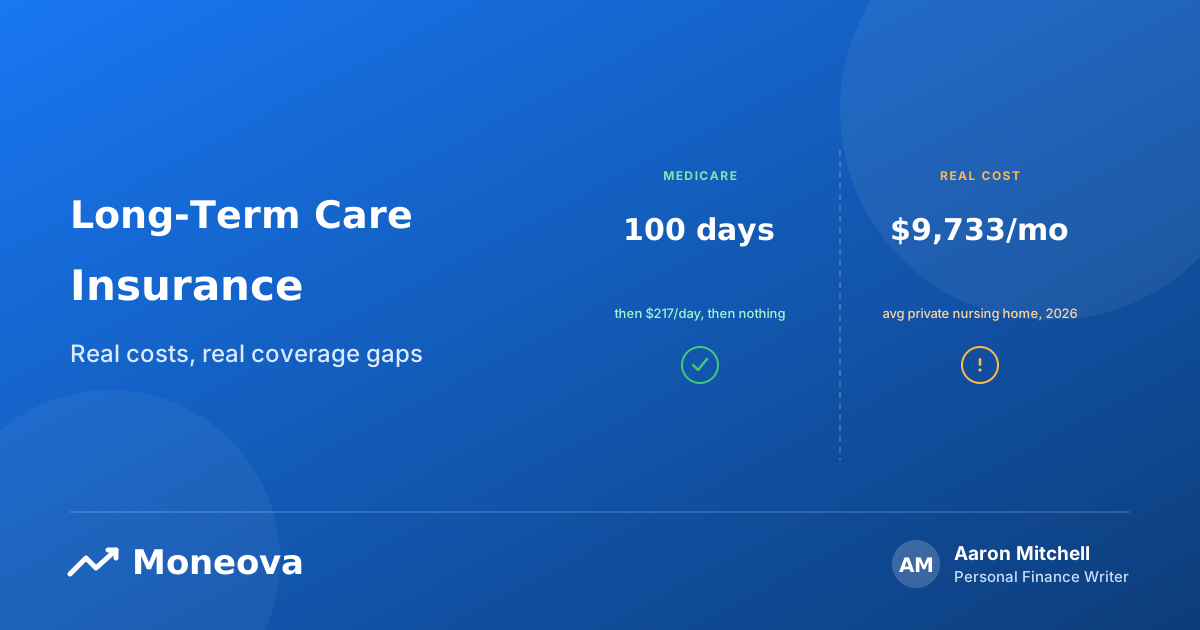
| Days 21-100 | $217 per day coinsurance |
| Day 101 onward | 100% of the cost, Medicare pays nothing |
CMS's official 2026 Medicare Parts A and B premiums and deductibles fact sheet confirms that $217 daily figure directly, up from $209.50 in 2025. Even within that 100-day window, Medicare only pays for skilled, medically necessary care, not the custodial help most long-term care actually consists of.
A 60-day stay in the coinsurance window alone runs roughly $13,020 out of pocket, and that's before day 101 arrives and the number goes to 100%.
3. What Long-Term Care Actually Costs in 2026
The numbers below come from the Genworth Cost of Care Survey, the industry's most widely cited annual benchmark, and they're the reason this decision matters financially, not just emotionally.
| Care type | Average monthly cost (2026) |
|---|---|
| In-home aide (44 hrs/week) | $6,292 |
| Assisted living facility | $5,900 |
| Nursing home, semi-private room | $8,929 |
| Nursing home, private room | $9,733 |
These are national medians. Regional variation is significant, and costs in high-cost metro areas can run well above these figures. The average nursing home stay runs about 2.5 years, but stays driven by Alzheimer's or other dementia frequently stretch to 5 to 10 years, which is exactly the scenario that turns a manageable cost into a genuinely catastrophic one.
4. How Long Would Your Own Savings Actually Last
Enter your liquid savings and the type of care you'd likely need, using the verified 2026 cost figures above.
Enter your liquid savings and the type of care you would likely need.
Illustrative only, not financial advice. Uses national median costs from the Genworth Cost of Care Survey 2026; regional variation is significant. Sources read 30 August 2026.
5. The Five Ways People Actually Pay for Long-Term Care
Long term health care insurance is one option among several, and which one fits depends mostly on age and assets, not preference.
- Traditional standalone LTC insurance. Best for ages 50-60 with $250,000 to $2 million in assets. Pays a daily or monthly benefit toward qualifying care. Cheapest per dollar of coverage when bought young, but it's use-it-or-lose-it: premiums aren't refunded if you never need care.
- Hybrid life/LTC policies. Combine a life insurance death benefit with an LTC rider. If you need care, the policy pays for it; if you don't, your heirs get the death benefit instead. No wasted premium, but a meaningfully higher cost per dollar of actual LTC coverage.
- Short-term care insurance. Covers up to 360 days, cheaper and easier to qualify for than traditional LTC, but not a substitute for it if you end up needing years of care rather than months.
- Medicaid. No premium, but strict income and asset limits, a 5-year look-back on transfers, and less choice over which facility you can use. The realistic path for households without significant assets to protect.
- Self-insuring. Setting aside assets instead of paying premiums. Financial planners generally suggest this becomes viable around $2 million in liquid assets, since the expected lifetime LTC cost is a manageable fraction of a portfolio that size.
6. The Long-Term Care Insurance Tax Deduction Most Guides Get Wrong
Qualified long-term care premiums are deductible as a medical expense, but the details trip up more people than the basic fact that a deduction exists.
| Age (as of Dec 31) | 2026 deductible limit per person |
|---|---|
| 40 or under | $500 |
| 41 to 50 | $930 |
| 51 to 60 | $1,860 |
| 61 to 70 | $4,960 |
| Over 70 | $6,200 |
IRS Revenue Procedure 2025-32, setting the 2026 inflation-adjusted limits sets these caps for 2026 under Internal Revenue Code Section 213(d)(10). They apply per person, so a married couple with policies at different ages each get their own cap.
Most non-self-employed taxpayers still need to clear the 7.5% AGI floor on total medical expenses before any of this actually reduces a tax bill; self-employed taxpayers deduct it above the line instead, with no floor to clear.
Here's the part almost nobody explains clearly: how the benefit itself gets taxed later depends on the policy's structure, not just whether it's "tax-qualified." Reimbursement policies, which pay actual documented care costs, are tax-free with no dollar limit at all.
Per-diem or indemnity policies, which pay a fixed daily amount regardless of actual costs, are only tax-free up to $430 a day in 2026, or your actual costs if higher. And many hybrid life/LTC policies don't qualify for the premium deduction at all, since they're often structured under a different part of the tax code than what Section 213(d)(10) requires.
7. Medicaid Long Term Care: The Real Backup Plan, With Real Rules
Nursing home Medicaid pays for roughly 60% of nursing home residents in the US, making Medicaid and nursing home care the largest single payer relationship of long-term care in the country, not a rare fallback.
Medicaid long term care is the largest such pathway, and CMS's own fact sheet on Medicaid's long-term services and supports program oversees the program, but qualifying for it specifically requires clearing three separate tests at once: a functional test showing you need help with daily activities, an income test, and an asset test. Most states cap countable assets at $2,000 for a single applicant.
A spouse who isn't entering care keeps a larger share, the Community Spouse Resource Allowance, capped at $162,660 in 2026, plus a Monthly Maintenance Needs Allowance up to $4,066.50 if their own income falls short.
The rule that catches the most families off guard is the 5-year look-back. Any asset transferred or gifted away in the 60 months before applying gets reviewed, and uncompensated transfers generate a penalty period, a stretch of ineligibility calculated by dividing the transferred amount by your state's average monthly nursing home cost.
Once approved, nearly all of your income goes toward the cost of care; you keep only a personal needs allowance, typically $40 to $130 a month, for your own use.
8. Long-Term Care Insurance Options: The Five Compared, Side by Side
Seeing the real numbers next to each other makes the age-and-assets logic click faster than reading each option separately.
| Option | Best ages to buy | Typical annual cost | Use it or lose it? |
|---|---|---|---|
| Traditional LTC insurance | 50-60 | $1,500-$3,000 (couple) | Yes |
| Hybrid life/LTC | 45-65 | Lump sum $100K+ | No |
| Short-term care insurance | 60-75 | $600-$1,800 | Yes |
| Medicaid planning | Any, plan early | $3K-$10K attorney fees | N/A |
| Self-insurance | Any | $0 premium | N/A |
Short-term care insurance is worth a specific mention: it caps out at 360 days of benefits, dramatically cheaper and easier to qualify for than traditional LTC, but a poor fit on its own if you end up needing years of care rather than months. It functions best as a bridge for people who can't qualify for or afford traditional coverage, not as a full replacement for it.
If you're weighing whether a whole life policy could double as part of this planning, our whole life insurance guide covers how those policies actually work.
9. When to Buy Long-Term Care Insurance: Age Is the Single Biggest Lever
More than health, more than which carrier you pick, age at purchase drives the cost of long-term care insurance more than any other factor.
Major carriers like John Hancock long term care ins policies illustrate this well: a 50-year-old typically pays roughly half what a 65-year-old pays for the identical coverage. That's not a small difference, and it compounds with a second problem: underwriting gets stricter with age too, so waiting doesn't just cost more, it risks disqualifying you entirely if a health condition develops in the meantime.
- Ages 45-55: The ideal window. Best rates, easiest underwriting.
- Ages 55-65: Still a reasonable time to buy; rates are higher but coverage remains genuinely valuable.
- Ages 65-70: Possible, but expensive, and existing health conditions may already limit options.
- 70 and older: Traditional LTC insurance becomes difficult to obtain at all; hybrid or short-term care policies are usually the remaining paths.
10. Long-Term Care Insurance: How You Actually Qualify, the Benefit Trigger
Before an elimination period ever starts counting, something more fundamental has to happen first: you have to be certified as meeting the policy's benefit trigger. This is the actual gate, and most explanations skip straight past it to talk about costs instead.
Under the federal tax-qualified standard that most policies use, a licensed health care practitioner has to certify one of two things. Either you can't perform at least 2 of 6 standard Activities of Daily Living without substantial assistance, for a period expected to last 90 days or longer, or you have a severe cognitive impairment requiring substantial supervision to protect you from health or safety threats.
| ADL | What it actually means |
|---|---|
| Bathing | Washing yourself in a tub, shower, or by sponge bath, including getting in and out safely |
| Dressing | Putting on and taking off clothing, including any braces, fasteners, or artificial limbs |
| Toileting | Getting to and from the toilet, on and off it, and the related personal hygiene |
| Transferring | Moving into or out of a bed, chair, or wheelchair, not the ability to walk |
| Eating | Feeding yourself once food is already prepared, not meal preparation itself |
| Continence | Controlling bladder and bowel function, or managing related hygiene if you can't |
The rule: needing substantial help with at least 2 of these 6, for 90 or more days, is what triggers benefits, not any single one alone.
Cognitive impairment is a genuinely separate path to qualifying, not a variation on the ADL count: someone with advanced dementia can trigger benefits while still physically capable of all six ADLs, because the actual risk is judgment and safety, not physical function.
A nurse or social worker assessment typically confirms this, not a single doctor's note, and once certified, that's what starts the elimination period clock running.
11. Long-Term Care Insurance: The Waiting Period and Health Screening Most Guides Skip
Two mechanics decide what actually happens between buying a policy and collecting on it, and neither gets much attention in most explainers.
The elimination period is a waiting period before benefits start, functioning like a deductible measured in days rather than dollars. It typically ranges from 0 to 180 days, most commonly 90, and you pay the full cost of care yourself during that window.
How those days get counted matters more than people expect: under the calendar-day method, every day counts once you qualify, whether or not you're actually receiving care that day.
Under the service-day method, only days you actually receive covered care count, so a home care plan of three visits a week only satisfies three days of the elimination period per week, stretching the real wait considerably longer than the stated number suggests.
Most policies only require satisfying this once, for the life of the policy, not separately for every claim.
Underwriting is the other piece. Traditional LTC insurance requires a health review, and it can result in denial or reduced coverage, not just a higher price. Conditions like Alzheimer's, Parkinson's, MS, a recent cancer diagnosis, or diabetes with complications commonly trigger decline or exclusion.
This is exactly why age matters as much for underwriting odds as for premium cost: waiting doesn't just make coverage more expensive, it risks a health event making coverage unavailable at any price.
12. Long-Term Care Insurance State Partnership Programs: A Real Protection Most People Never Hear About
This is the single biggest gap in most explanations of how long-term care insurance and Medicaid actually connect.
Long-Term Care Partnership Programs exist in roughly 40 states as of 2026. Buy a qualifying policy, and every dollar it pays out toward your care protects an equal dollar of your own assets from Medicaid's spend-down requirement, dollar for dollar, including protection from estate recovery after you're gone.
A $300,000 policy that pays out in full means you can keep $300,000 in assets and still qualify for Medicaid, instead of spending it down to the standard $2,000 limit.
Two catches are worth knowing before assuming this applies to you. Only traditional standalone LTC policies generally qualify; employer group policies and hybrid life/LTC policies typically don't.
Having a program on the books doesn't guarantee you can actually buy in: California and New York both have approved Partnership programs, but as of 2026 neither state currently has carriers actively selling new qualifying policies, a real, practical gap between what the program allows and what you can actually purchase. Indiana uses a more generous total-asset-protection model instead of the standard dollar-for-dollar approach most states use.
Confirming your specific state's current status, and which carriers are actually selling there, is worth doing before assuming this protection is available to you.
13. A Real Example: Same Care Need, Three Different Outcomes
Robert, Linda, and James each end up needing a private nursing home room, $9,733 a month, for a 3-year stay, roughly $350,000 in total.
| Robert | Linda | James | |
|---|---|---|---|
| Approach | Bought LTC insurance at 55 | Self-insured, $2.5M in assets | No insurance, $40,000 in savings |
| Out-of-pocket for the stay | Mostly covered by policy | ~14% of total assets | Savings gone in about 4 months |
| What happens after | Policy limits may cap total payout | Portfolio absorbs the cost | Medicaid spend-down and application |
Robert's premiums over the years were real money spent whether or not he ended up needing care. James, without planning, ends up on Medicaid anyway, just after losing the choice about when and how that transition happened. Linda's outcome depended entirely on having enough assets to absorb the hit without insurance at all.
14. Frequently Asked Questions
15. Final Thoughts
Long-term care insurance solves a real, specific problem: a cost Medicare mostly won't cover, arriving at an age when income has usually already peaked. It's genuinely one of five real paths, not the only one, and which path fits depends on your age and your assets more than on which policy sounds best.
Whatever path you're leaning toward, get the actual numbers first: what care would cost where you live, what your own savings would actually cover, and how much time you realistically have before age starts working against the underwriting. Waiting rarely helps this particular decision. If retirement savings are part of that picture, our investing basics guide covers how long-term goals like this one fit into a broader plan.
This article is for general information only and is not insurance, financial, tax, or legal advice. Insurance policy details, coverage terms, and IRS figures cited here were current as of 30 August 2026 and update periodically; Medicaid rules also vary significantly by state. Confirm current figures and how they apply to your specific situation with a qualified financial advisor, elder law attorney, or tax professional before making a decision. Figures in examples are illustrative, not guarantees of any specific outcome.Disclaimer.