 Loans
Loans
Physician Loan Explained: No Down Payment, No PMI, Real Rules
Banks don't usually hand out zero-down mortgages to people carrying $200,000 in student debt with no pay stubs yet. For physicians, dentists, and a handful of other high-earning professionals, plenty of lenders do exactly that.
This article covers what makes a physician loan actually different, the student loan mechanic that drives most approvals, a genuine calculator comparing the real cost trade-off, and the one rule of thumb lenders have no reason to volunteer.
1. What a Physician Loan Actually Is
Home loans for doctors exist because banks want physicians as clients badly enough that they built an entire loan category to attract them. A physician loan, also called a doctor loan, lets qualifying medical professionals buy a home with little or no down payment and no private mortgage insurance, even carrying six figures of student debt that would sink a conventional application.
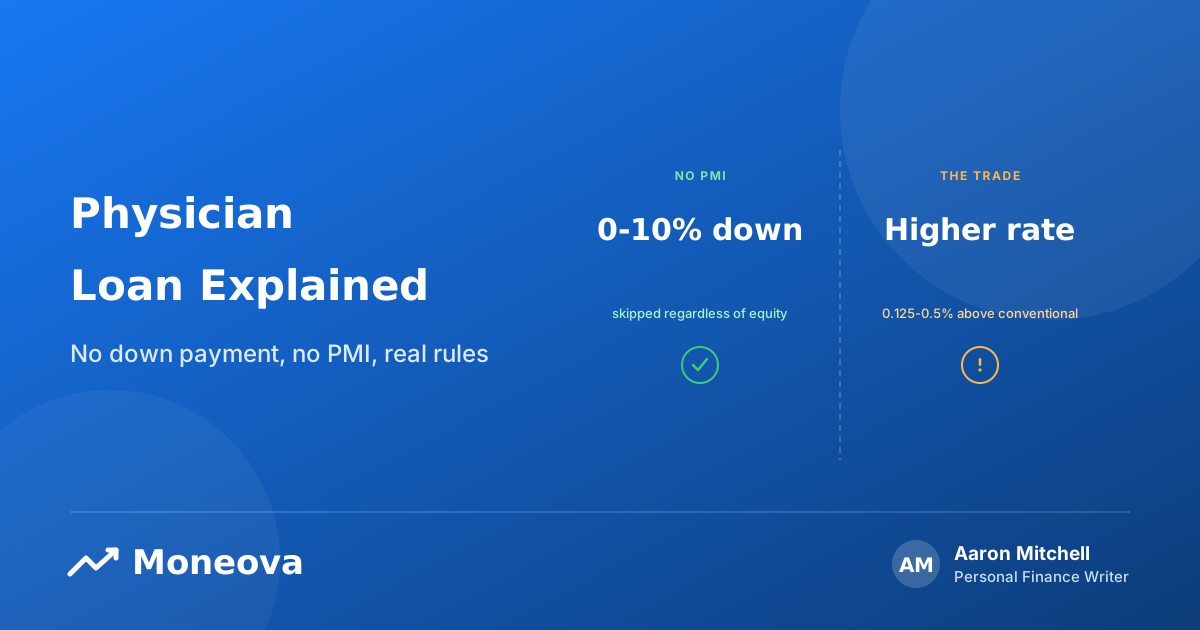
A zero down physician mortgage isn't charity. the CFPB's explanation of private mortgage insurance_LINK explains why lenders normally require PMI: it protects them if a low-equity borrower defaults. Physician loan lenders skip that protection because they've decided doctors default at low enough rates, and bring enough other business, to be worth the risk without it.
Physician lending has no single government-standardized version the way there is a VA or USDA loan. Every bank runs its own version, with its own rules, its own eligible degree list, and its own numbers. What follows are the patterns that hold true across most programs, not one universal rulebook.
2. Physician Loan Eligibility: Who Actually Qualifies
Physician home loans keep their own eligibility lists, but MD, DO, DDS, and DMD show up almost everywhere. Many programs extend further: DPM (podiatry), OD (optometry), PharmD, VMD (veterinary), and CRNA are common additions, and a smaller number of lenders include physician assistants, nurse practitioners, and even attorneys or accountants under a broader professional loan umbrella.
Availability also varies by state, since not every lender operates nationwide; checking physician loans by state before assuming a specific program is even offered where you're buying saves a wasted application.
Credit and income numbers vary more than the degree lists do.
| Typical range | |
|---|---|
| Minimum credit score | 660-720, most commonly 680 |
| Maximum physician loan debt to income ratio | 43-50% |
| Down payment | 0-10% |
| Loan amount ceiling | $1M-$2M, sometimes higher with a partial down payment |
A resident physician mortgage loans path is explicitly included by most programs, not just attendings. This matters more than it sounds: a resident earning $65,000 with $250,000 in medical school debt is exactly the profile this loan category exists for, not an edge case.
3. Physician Loan Student Loans: How They Actually Get Treated
This is the single mechanic that separates a physician loan from everything else, and it's worth understanding precisely rather than taking on faith.
A medical doctor mortgage applicant faces a stricter default: a conventional or FHA lender typically calculates your student loan payment as 1% of the outstanding balance per month, regardless of what you actually pay. On $250,000 in loans, that's $2,500 a month counted against you, whether or not that's remotely close to your real payment.
Physician mortgage underwriting works differently. the Department of Education's overview of income-driven repayment plans_LINK describes income-driven repayment plans like IBR and PAYE, and physician lenders typically use your actual IDR payment instead of that inflated 1% figure.
This distinction alone is why student loan treatment matters so much. If your loans are deferred for 12 months or more from your closing date, some lenders exclude them from the debt-to-income calculation entirely. For a resident with a low current income and a large loan balance, this single difference is often what separates a denial from an approval.
4. Should a Resident Even Get a Physician Loan Right Now?
Qualifying for a physician loan and being ready to buy a home aren't the same question, and the second one deserves more weight than lenders tend to give it.
Residencies and fellowships typically run three to five years, often at a single location you didn't fully choose. Homes generally take about five years to break even once you count buying and selling costs, so a training position shorter than that stretch means renting frequently costs less overall, even before factoring in the hassle of selling on a compressed timeline.
There's a tax wrinkle too. A resident's income is usually low enough that the standard deduction beats itemizing, which means mortgage interest often isn't actually reducing your tax bill the way people assume it will.
Combined with the 1-2% of home value that maintenance typically costs every year, the case for renting through training and buying once you're settled as an attending is stronger than the marketing for these loans usually lets on.
5. Physician Loan Closing Costs and Non-Occupying Co-Borrowers
Two practical details rarely make it into the headline pitch, and both are worth asking about upfront.
Closing costs on a physician loan generally land in the same 2% to 5% of loan amount range as any other mortgage, not meaningfully higher just because of the program. Skipping a down payment doesn't skip these costs, so budgeting for them separately from the down payment matters.
Some programs also allow a non-occupying co-borrower, someone who isn't going to live in the home but whose income or credit strengthens the application, and separately allow gift funds toward reserves rather than requiring every dollar to be earned and seasoned in your own account. Neither is universal, but both are worth asking about directly if your own numbers are borderline.
6. The Real Physician Loan Trade-off: Higher Rate vs No PMI
Enter your loan amount, the rate premium a physician loan is quoting you, and what PMI would cost on the conventional alternative.
Enter your loan amount, the rate premium quoted, and what PMI would cost on the conventional alternative.
Illustrative only, not a lending decision. Simplified comparison; actual PMI and rate calculations vary by lender and loan structure. Sources read 23 August 2026.
7. A Physician Loan Lets You Buy Before Your First Paycheck
Conventional lenders want two years of income history. A signed employment contract with a confirmed start date is usually enough for a physician loan, which is exactly what makes it possible to close on a home before residency or a new attending position even begins.
Most programs allow closing 60 to 90 days ahead of the start date. Underwriters are betting on your contracted future income, not your current resident-level pay, which is the whole point of the product.
8. The Physician Loan Rule Lenders Won't Tell You, Because It Costs Them Money
Being approved for a loan amount and being able to comfortably afford it are two completely different numbers, and the gap between them can be enormous.
Run a real example: a physician earning $400,000 a year, using standard 28%/36% underwriting guidelines, could get approved for a physician mortgage loan close to $2 million, a debt-to-income multiple of roughly 5 times their annual salary.
The White Coat Investor's independent guide to doctor mortgage loans_LINK argues, and this is worth taking seriously, that a much safer target is 1 to 2 times gross income, which on that same $400,000 salary caps a sensible mortgage closer to $400,000 to $800,000, not $2 million.
Nobody at the bank is going to volunteer this. Being approved for more house tells you what the lender is willing to risk, not what actually leaves room in your budget for retirement savings, the rest of your debt, and everything else that isn't your mortgage payment.
9. What a Physician Loan Won't Cover
The flexibility on income and down payment comes with real restrictions elsewhere.
- Primary residence only, almost always. Investment properties and vacation homes are excluded by nearly every program. Buying a rental with a physician loan is generally not an option; a separate investment-property loan structure would be needed instead.
- Single-unit properties, typically. Most programs stick to one-unit homes, sometimes condos depending on the lender, rarely multi-unit buildings.
- A cap on how long you're eligible. Some banks stop offering physician loans once you're more than 10 years removed from training, on the logic that by then you should qualify conventionally on your own income and savings.
- One or two active physician loans at a time, not unlimited, though the exact cap depends entirely on the lender.
10. When Refinancing Out of a Physician Loan Makes Sense
A physician loan isn't meant to be permanent. Most doctors who use one plan to refinance into a conventional loan once their financial picture changes, and for most, it changes fast.
The signal to watch for is simple: once your income has risen, your DTI has dropped, your credit score has climbed, and your home equity has crossed 20%, either through paying down the loan or the home appreciating, a conventional refinance usually beats staying on the physician loan's rate premium.
None of the physician loans covered here typically carry a prepayment penalty, so there's no cost to refinancing the moment the math favors it.
Many attendings hit this crossover within three to five years of finishing training. Checking the numbers annually, rather than assuming the original loan is permanent, is worth the ten minutes it takes. Our debt-to-income ratio guide covers the exact calculation a conventional lender will run when you eventually make that switch.
11. Physician Loan Fixed vs Adjustable: A Real Choice, Not a Default
Physician loans come in both fixed-rate and adjustable-rate structures, and which one fits depends heavily on how long you expect to stay.
An adjustable-rate mortgage, commonly structured as a 5/6, 7/6, or 10/6 ARM, holds a fixed rate for the first five, seven, or ten years, then adjusts periodically after that.
For a resident or fellow who expects to relocate for a new position in a few years, the lower initial ARM rate can mean genuine monthly savings during exactly the years income is tightest, without ever holding the loan long enough to feel the adjustment.
An attending settling into a long-term home should generally lean fixed instead. The whole advantage of an ARM depends on leaving before the fixed period ends; staying past that point hands the rate risk back to you with none of the upside.
12. A Real Physician Loan Example: Same Income, Different Paths
Dr. Patel and Dr. Nguyen both just finished residency, each earning $250,000 as new attendings, each carrying $220,000 in student loans on an income-driven repayment plan.
| Dr. Patel | Dr. Nguyen | |
|---|---|---|
| Loan type | Physician loan, 0% down | Conventional, saved 20% down |
| Loan amount | $600,000 | $480,000 (on a $600,000 home) |
| PMI | None | None (20% down avoids it entirely) |
| Rate | ~0.25% above conventional | Standard conventional rate |
| Cash needed at closing | Closing costs only | $120,000 down plus closing costs |
Dr. Nguyen's path costs less over the life of the loan, but requires $120,000 in savings neither doctor necessarily has straight out of residency. Dr. Patel's path costs a bit more in interest but doesn't require having that cash sitting in a bank account first.
Neither choice is wrong; they're solving for different constraints. If neither path fits and a government-backed option is on the table instead, our FHA vs conventional loan guide covers the two most common alternatives.
13. Frequently Asked Questions
14. Final Thoughts
A physician loan solves a real, specific problem: high income potential colliding with high student debt and little savings, right at the start of a career. It isn't automatically the cheapest option, and it isn't meant to be; it's meant to make homeownership possible on a timeline that conventional underwriting doesn't accommodate.
The math on whether it's worth the rate premium depends entirely on your specific numbers, not a rule of thumb. Run your own loan amount, your own quoted rate difference, and what PMI would actually cost you on the conventional path before deciding either way.
This article is for general information only and is not a lending decision or financial advice. Physician loans are not a standardized government program; terms, rates, eligible degrees, and DTI limits vary significantly by lender and were current as of 23 August 2026. Confirm current terms directly with specific lenders before making a decision. Figures in examples are illustrative, not guarantees of any specific outcome.Disclaimer.