 Investing
Roth IRA vs Traditional IRA: Which One Is Right for You?
Every year millions of people open an IRA (Individual Retirement Account) without being entirely sure which kind they chose, or why. The most common version of the question is IRA vs Roth IRA vs 401k, which really asks three things at once. The two options, Roth and traditional, look similar from the outside and produce very different results over decades.
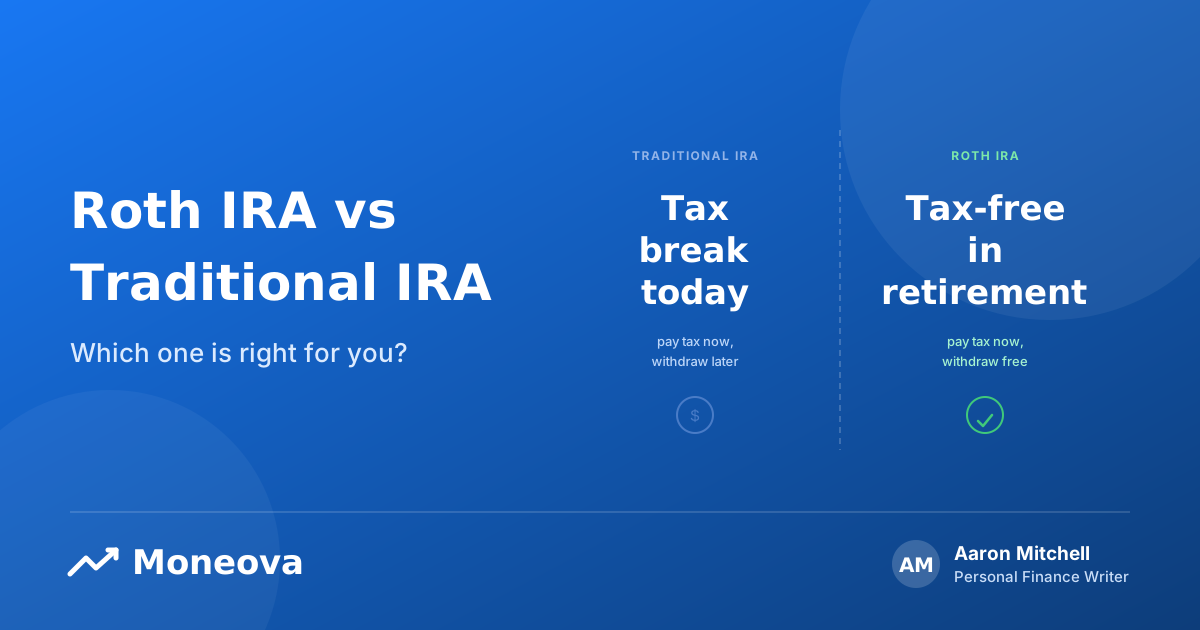
The choice turns on one question: is your tax rate higher now or higher when you retire? Pay tax now on a smaller amount and withdraw free later. Or reduce your tax bill today and pay on the larger amount later. Neither answer is obviously correct, and the best position for most people is to hold both.
The difference between a Roth IRA (Individual Retirement Account) and a traditional IRA (Individual Retirement Account) is simple in principle. This article covers the 2026 contribution limits and income thresholds from the IRS (Internal Revenue Service) directly, the backdoor Roth IRA for high earners and the pro-rata trap inside it that most guides skip, the no-RMD (no Required Minimum Distribution) advantage that compounds quietly for decades, and the conversion strategy that turns low-income years into a permanent tax saving.
1. What an IRA Is, and Why There Are Two Kinds
An IRA (Individual Retirement Account) is a personal savings account with tax advantages built in by Congress to encourage retirement saving. You open it yourself, independent of any employer, and you can hold almost any investment inside it: shares, bonds, funds, certificates of deposit.
There are two main kinds, and the difference between them comes down to a single question: when do you want the tax break?
| Traditional IRA (Individual Retirement Account) | Roth IRA (Individual Retirement Account) | |
|---|---|---|
| When you get the tax break | Now: contributions may reduce your taxable income | Later: qualified withdrawals are tax-free |
| Tax on contributions | Pre-tax (may be deductible) | After-tax (no deduction) |
| Tax on growth inside the account | Deferred until withdrawal | None |
| Tax on qualified withdrawals | Taxed as ordinary income | None |
| Required withdrawals at a certain age? | Yes, from age 73 | No, not during the owner's lifetime |
| Income limit to contribute? | No (deductibility has limits) | Yes |
Whether you search IRA vs Roth IRA or Roth vs traditional IRA, the answer is the same: these are the same account structure, taxed at opposite ends. Both accounts shelter investment growth from annual tax. The difference is the timing of when the government takes its share, and the answer to that question drives the entire decision between them.
The difference between Roth IRA and traditional IRA, the difference between a Roth IRA and a traditional IRA in full terms, is simply when you pay the tax.
2. The 2026 Numbers: Contribution Limits and Income Thresholds
The IRS (Internal Revenue Service) sets new limits each year. For 2026 the figures come from IRS Notice 2025-67 and IRS Rev. Proc. (Revenue Procedure) 2025-32, published in late 2025.
| Limit | 2026 amount |
|---|---|
| Annual IRA (Individual Retirement Account) contribution, under 50 | $7,500 |
| Annual IRA contribution, age 50 or older (includes catch-up) | $8,600 |
| 401(k) (employer-sponsored retirement plan) limit, under 50 | $24,500 |
| Combined IRA limit across all your IRAs (not per account) | $7,500 or $8,600 |
Two things worth noting. First, the $7,500 limit applies across all your IRAs combined, not per account. If you have both a traditional and a Roth IRA, the total going into both cannot exceed $7,500. Second, you cannot contribute more than you earned. If your income for the year was $4,000, your IRA limit is $4,000, not $7,500.
2.1 Roth IRA Income Limits 2026 and Roth IRA Contribution Limits 2026
A Roth IRA has an income ceiling. Above a certain level of MAGI (Modified Adjusted Gross Income, which is your income before certain deductions), your ability to contribute is reduced and eventually eliminated.
| Filing status | Full contribution | Partial contribution (phase-out) | No contribution |
|---|---|---|---|
| Single / Head of household | MAGI below $153,000 | $153,000 to $168,000 | Above $168,000 |
| Married filing jointly (MFJ) | MAGI below $242,000 | $242,000 to $252,000 | Above $252,000 |
| Married filing separately (MFS) | None | $0 to $10,000 | Above $10,000 |
The phase-out band is not a cliff. Between $153,000 and $168,000 as a single filer you can still contribute something, just not the full $7,500. The formula: divide the distance between your MAGI and the top of the phase-out by the width of the band, and multiply that fraction by the contribution limit. A single filer earning $160,000, for example, has used $7,000 of the $15,000 band, so can contribute 53% of $7,500, which is about $3,975.
The IRS Publication 590-A on contributions to IRAs gives the exact worksheet if you want to calculate your precise allowance.
2.2 Traditional IRA deductibility limits for 2026
Anyone with earned income can contribute to a traditional IRA. The question is whether that contribution is deductible. If you or your spouse are covered by a workplace plan such as a 401(k), deductibility phases out above certain income levels.
| Filing status and plan coverage | Full deduction | Partial deduction | No deduction |
|---|---|---|---|
| Single, covered by workplace plan | MAGI below $81,000 | $81,000 to $91,000 | Above $91,000 |
| Married filing jointly (MFJ), covered spouse contributes | Below $129,000 | $129,000 to $149,000 | Above $149,000 |
| MFJ, not covered but spouse is covered | Below $242,000 | $242,000 to $252,000 | Above $252,000 |
| No workplace plan | Always fully deductible | Not applicable | Not applicable |
If a traditional IRA contribution is not deductible at your income level, it is still worth making in some cases, particularly as part of a backdoor Roth IRA (explained in section 7). A non-deductible contribution still grows tax-deferred inside the account.
The IRS newsroom announcement of the 2026 retirement plan limits is the primary source for the 2026 figures above.
2.3 The Saver's Credit: a second benefit low and moderate earners often miss
Beyond the deduction or tax-free growth, contributing to either IRA type can unlock the Retirement Savings Contributions Credit, better known as the Saver's Credit, worth up to 50 percent of your contribution as a direct reduction in the tax you owe, not just a deduction from income.
| Filing status | 2026 income limit |
|---|---|
| Married filing jointly | $80,500 |
| Head of household | $60,375 |
| Single or married filing separately | $40,250 |
The credit rate, 50%, 20%, or 10% of your contribution, depends on exactly where your income falls within these limits, and it applies whether you contribute to a traditional IRA, a Roth IRA, or both. It stacks on top of whatever deduction or tax-free growth benefit the account itself already provides, which makes it one of the most overlooked pieces of the traditional-versus-Roth decision for anyone near these income levels.
3. How a Traditional IRA Works in Practice
You put money in, the contribution may reduce your taxable income for the year, and the investments grow without annual tax. When you take money out in retirement, withdrawals are taxed as ordinary income at whatever your rate is then.
- Contributions may be deductible. At most income levels they are, which means the government is effectively subsidising your contribution by the amount of tax you would have paid on that money.
- Growth is tax-deferred, not tax-free. You pay no annual tax on dividends or capital gains inside the account, but the bill waits for you at withdrawal.
- Withdrawals in retirement are taxed as ordinary income. Not at capital gains rates, but at your income tax rate, which could be 22%, 24%, or higher.
- Early withdrawals before age 59½ trigger a 10% penalty plus ordinary income tax. Exceptions exist for disability, first home purchase (up to $10,000 lifetime), higher education costs and a handful of others.
- RMDs (Required Minimum Distributions) begin at age 73. You must withdraw a government-calculated minimum each year based on your account balance and life expectancy, whether you need the money or not. Fail to take the RMD and the penalty is 25% of the amount you should have withdrawn.
The RMD (Required Minimum Distribution) rule is the one most people underestimate when they are young. By 73, a traditional IRA can hold hundreds of thousands of dollars. The forced withdrawals can push you into a higher bracket and affect Medicare (health insurance programme for people aged 65 and over) premium surcharges. That involuntary income is the hidden cost of the traditional IRA's upfront deduction.
4. How a Roth IRA Works in Practice
You put in after-tax money, the contribution does not reduce your taxable income today, and the investments grow. When you take money out in retirement, qualified withdrawals are completely tax-free, including all the growth.
- No deduction on the way in. You pay tax on the money before contributing. What goes in has already been taxed.
- Growth is genuinely tax-free. A Roth IRA that grows from $50,000 to $400,000 over 30 years produces $350,000 of earnings that will never be taxed.
- Qualified withdrawals are tax-free. Two conditions: you are at least 59½ and the account has been open for at least five tax years (the five-year rule). Meet both and the money, all of it, comes out free.
- Contributions (not earnings) can be withdrawn at any time, penalty-free. Because you already paid tax on contributions, the IRS (Internal Revenue Service) does not restrict access to them. Only the growth has the five-year and age requirements.
- No RMDs (Required Minimum Distributions) during your lifetime. You can let the account grow indefinitely. This is the most underrated advantage of the Roth, and it is covered in full in section 6.
5. The Core Decision: Will Your Tax Rate Be Higher Now or Later?
Roth IRA or traditional IRA, also phrased as Roth IRA and IRA difference, the core question is the same: does your tax rate go up or down between now and retirement?
| Your situation | Likely better choice | Reason |
|---|---|---|
| Early career, low income now, expect to earn more | Roth IRA | Pay tax at today's low rate, withdraw tax-free when your rate is higher |
| Peak earning years, high tax bracket now | Traditional IRA | The deduction is worth more when your rate is high; withdraw at a potentially lower rate in retirement |
| Uncertain; income varies year to year | Both, or Roth as default | Tax diversification lets you manage income in retirement across taxable and tax-free sources |
| Expect to leave money to heirs | Roth IRA | No RMDs (Required Minimum Distributions), and heirs inherit tax-free growth |
| Income above the Roth phase-out | Traditional IRA or backdoor Roth | Direct Roth contributions not allowed above $168,000 single / $252,000 MFJ (Married Filing Jointly) |
| Roth IRA vs 401k: no employer match on the 401k | Roth IRA first | More investment flexibility and no forced withdrawals |
The honest answer is that predicting your future tax rate is genuinely hard. Congress changes tax brackets. Retirement income sources vary. A person who expects to be in a lower bracket in retirement often finds that Social Security, RMDs (Required Minimum Distributions), pensions and investment income push them back up.
That uncertainty is the strongest argument for having both rather than choosing one.
6. The No-RMD Advantage: The Part Most Young Savers Dismiss
When you are 30 and opening an IRA (Individual Retirement Account), the concept of Required Minimum Distributions (RMDs) at age 73 feels irrelevant. It is worth thinking about anyway, because it affects the decision more than most people realise.
A traditional IRA at 73 is not yours to manage freely. The IRS (Internal Revenue Service) calculates a minimum you must withdraw each year using a table based on your life expectancy and your account balance. You take that out whether you need it or not. The money is then taxed as ordinary income.
Three consequences that matter:
- Forced income can push you into a higher bracket. A retiree living modestly on Social Security (government retirement benefit) and a small pension may have low taxable income, until RMDs (Required Minimum Distributions) from a large traditional IRA add $40,000 or $50,000 a year of involuntary taxable income.
- IRMAA (Income-Related Monthly Adjustment Amount) surcharges on Medicare. Medicare premium surcharges are triggered at certain income levels. A large RMD (Required Minimum Distribution) can push someone over the threshold and increase their monthly Medicare cost by hundreds of dollars.
- A large account means large RMDs. An account that has grown to $800,000 produces RMDs (Required Minimum Distributions) of roughly $30,000 in the first year, rising each year as the account grows or the life expectancy divisor shrinks.
A Roth IRA (Individual Retirement Account) has none of this. The money can sit there indefinitely, growing tax-free, available when you want it and untouched when you do not. For someone who has other income sources in retirement, the Roth's no-RMD (no Required Minimum Distribution) structure can be more valuable than the traditional IRA's upfront deduction.
The IRS Publication 590-B on distributions from IRAs covers the RMD (Required Minimum Distribution) calculation rules in full.
7. The Backdoor Roth IRA, and the Pro-Rata Trap Inside It
If your income is above the Roth IRA (Individual Retirement Account) phase-out ceiling, you cannot contribute directly. There is a legal workaround, but it carries a trap that most guides do not explain properly.
The backdoor Roth IRA (Individual Retirement Account) works in two steps:
- Step 1: Make a non-deductible contribution to a traditional IRA (Individual Retirement Account). There are no income limits on this, only on deductibility.
- Step 2: Convert that traditional IRA money to a Roth IRA. This is a taxable event, but because the contribution was non-deductible, the amount converted carries no further tax owed, assuming you act quickly and the account has not grown.
The trap is called the pro-rata rule, and it only fires if you have other pre-tax traditional IRA money sitting anywhere under your name.
| Example A: no existing IRA | Example B: has $90,000 pre-tax IRA | |
|---|---|---|
| Non-deductible contribution | $7,500 | $7,500 |
| Existing pre-tax IRA balance | $0 | $90,000 |
| Total IRA value | $7,500 | $97,500 |
| Pre-tax proportion | 0% | 92.3% ($90,000 ÷ $97,500) |
| Taxable amount on converting $7,500 | $0 | $6,923 |
Person A gets a clean backdoor Roth. Person B converts the same $7,500 but owes tax on $6,923 of it because the IRS (Internal Revenue Service) sees the conversion as coming proportionally from all their IRA money, not just the new non-deductible contribution. The same rules apply to SEP-IRA (Simplified Employee Pension Individual Retirement Account) and SIMPLE IRA (Savings Incentive Match Plan for Employees Individual Retirement Account) balances.
The way around it: roll the existing pre-tax IRA into a current employer's 401(k) (employer retirement plan) before doing the conversion, which removes those balances from the pro-rata calculation. Not all 401(k) plans accept rollovers, so check first.
8. Can You Have Both? Yes, and Often You Should
This is the most common misconception about IRAs (Individual Retirement Accounts): people treat the Roth vs traditional choice as either/or. It is not. You can contribute to both in the same year, as long as the total does not exceed the annual limit.
- $7,500 total (or $8,600 if 50 or older), split however you want between the two accounts.
- You can also have a 401(k) (employer retirement plan) at the same time. Contributing to a 401(k) does not reduce your IRA (Individual Retirement Account) contribution room. They are separate limits.
- The practical strategy for Roth IRA or 401k decisions, also written as Roth vs 401: 401(k) up to the employer match first (free money), then Roth IRA (Individual Retirement Account) to the $7,500 limit, then back to the 401(k) if you still have room. This is a widely recommended order because the Roth IRA offers more investment flexibility and no forced withdrawals.
Having both a traditional and a Roth IRA is called tax diversification, and it is genuinely useful in retirement. With money in both types of account you can choose which to draw from each year based on your tax situation in that year, withdrawing from the traditional IRA in low-income years and from the Roth in high-income years, optimising your rate as you go.
Our guide to the basics of investing covers how IRAs (Individual Retirement Accounts) fit into a broader investment plan.
9. The Spousal IRA: One Income, Two Accounts
A non-working spouse can contribute to their own IRA (Individual Retirement Account) based on the working spouse's earned income. Most people do not know this exists.
The rules are simple. The couple must file jointly (MFJ, Married Filing Jointly). The contributing spouse must have enough earned income to cover both contributions. And both contributions are subject to the same income limits and deductibility rules as individual contributions.
| Scenario | Combined IRA contribution room |
|---|---|
| Both under 50 | $15,000 ($7,500 each) |
| Both 50 or older | $17,200 ($8,600 each) |
| One over 50, one under | $16,100 ($8,600 + $7,500) |
For a household where one partner takes time out of paid work to raise children or care for a family member, the spousal IRA (Individual Retirement Account) prevents a gap in their retirement savings. The non-working spouse builds their own Roth IRA (Individual Retirement Account) entirely, separate from their partner's accounts, which is also relevant if circumstances change.
10. A Real Example: The Roth Conversion Strategy in Practice
You can convert money from a traditional IRA (Individual Retirement Account) to a Roth IRA at any time. The amount converted is added to your taxable income for the year and taxed as ordinary income. There is no penalty.
This sounds like a bad deal until you think about when to do it.
People who retire early, take a career break, or have a low-income year for any reason often find themselves in an unusually low tax bracket. That gap, between when their income drops and when other income sources (Social Security, pensions, RMDs (Required Minimum Distributions)) begin, is the window. Converting traditional IRA money to Roth in that window means paying tax at 10% or 12% on money that would otherwise be taxed at 22% or higher when RMDs (Required Minimum Distributions) force withdrawals later.
| Without conversion | With conversion in low-income years | |
|---|---|---|
| Tax paid on the converted amount | Not applicable | 10-12% (in a low bracket) |
| Tax on RMDs (Required Minimum Distributions) later | 22-24% or higher | Reduced or zero if account is smaller |
| Tax on growth | Taxed at ordinary rates when withdrawn | Zero, permanently |
| Estate tax position | Heirs inherit taxable account | Heirs inherit tax-free account |
The five-year rule applies separately to each conversion: money converted must sit in the Roth for five years before the converted amount can be withdrawn penalty-free (if under 59½). This is why the strategy is called a conversion ladder: you start five years before you need access to the money, converting a portion each year.
Our guide to capital gains tax covers how income levels affect tax rates more broadly, which is the same planning principle.
11. Work Out Your Own IRA Position
Your Roth IRA eligibility and the value of a traditional IRA deduction both depend on your income. Put your own numbers in and this works out whether you can contribute to a Roth, how much if you are in the phase-out range, and whether a traditional IRA contribution would be deductible.
Your Roth IRA (Individual Retirement Account) eligibility and the value of a traditional IRA deduction both depend on your income and filing status. Put your numbers in and this works out what you can contribute in 2026.
2026 figures from IRS (Internal Revenue Service) Notice 2025-67 and Rev. Proc. (Revenue Procedure) 2025-32, read 11 August 2026. Illustrative only, not tax or financial advice. MAGI (Modified Adjusted Gross Income) may differ from gross income depending on deductions and adjustments. Traditional IRA (Individual Retirement Account) deductibility depends on whether you or your spouse participate in a workplace plan; consult IRS Publication 590-A or a qualified tax adviser for your exact position.
12. Mistakes That Cost Money
Most IRA (Individual Retirement Account) errors are preventable once you know the rules.
- Treating the IRA choice as permanent. You can have both. You can convert. You can change your strategy as income changes.
- Ignoring the phase-out calculation. Many people between $153,000 and $168,000 (single) assume they cannot contribute to a Roth at all. They can, just a reduced amount.
- Doing a backdoor Roth while holding pre-tax IRA money. The pro-rata rule turns what looks like a clean conversion into a partially taxable one. Check your total IRA balances before converting.
- Missing the contribution deadline. IRA (Individual Retirement Account) contributions for a given tax year can be made up to the tax filing deadline the following year. A 2026 contribution can be made any time up to 15 April 2027.
- Forgetting the five-year rule on a Roth. Opening the account matters, even if you only put in a small amount. The five-year clock starts from the tax year of the first contribution.
- Not using a spousal IRA (Individual Retirement Account). A non-working spouse can contribute based on the working spouse's income. This doubles the household contribution room many couples never use.
- Taking RMDs (Required Minimum Distributions) late. The penalty is 25% of the amount you should have taken. At age 73 this becomes a deadline worth tracking.
- Withdrawing Roth earnings early without meeting the five-year rule. Contributions come out free. Earnings trigger tax and a 10% penalty if the account is not yet five years old or you are under 59½.
The IRS page on traditional and Roth IRAs summarises the rules for both account types on one page and is worth bookmarking.
Frequently Asked Questions
Final Thoughts
The choice between a Roth IRA (Individual Retirement Account) and a traditional IRA is not a one-time decision. It is a question you can revisit every year, adjusting your mix as your income changes, converting in low-income years, and building both types of account for the flexibility they give you in retirement.
The Investor.gov introduction to investment products and the IRS publications linked throughout this article are worth bookmarking alongside this guide. The two actions worth taking now regardless of which you choose: make sure the five-year clock on any Roth IRA (Individual Retirement Account) you intend to open has started, and if you have a non-working spouse, open a spousal IRA (Individual Retirement Account) for them. Both of these take less than thirty minutes and compound for decades.
This article is for general information only and is not tax or financial advice. The 2026 IRA (Individual Retirement Account) contribution limits, income phase-out thresholds and deductibility rules are set by the IRS (Internal Revenue Service) and were read on 11 August 2026; they are adjusted most years and may change. The backdoor Roth IRA and Roth conversion strategies involve tax consequences that depend on your individual circumstances, including your total IRA balances and the pro-rata rule. RMD (Required Minimum Distribution) ages and penalties reflect the SECURE 2.0 Act (Setting Every Community Up for Retirement Enhancement Act) rules as of the date of writing. Dollar figures are illustrative examples. Consult a qualified tax adviser before acting.Disclaimer.