 Loans
Loans
VA Home Loan Explained: Entitlement, Eligibility, and Hidden Rules
The VA doesn't lend you money, and that one fact changes how almost everything else about this benefit works. Once you understand what the VA actually does, entitlement, funding fees, and property rules stop feeling like separate confusing pieces and start looking like one mechanic applied consistently.
This article covers the entitlement math most guides get wrong, exactly how much the funding fee costs and who's exempt, which properties actually qualify, and a real hardship program that's new enough most existing content doesn't have it yet.
1. What a VA Home Loan Actually Is
The VA doesn't lend you money. That surprises a lot of people starting out.
A VA home loan comes from an ordinary private lender, a bank, credit union, or mortgage company. What the Department of Veterans Affairs does is guarantee a portion of that loan. If you default, the VA covers part of the lender's loss.
That guaranty changes how the lender prices your risk. Normally, a borrower with no down payment looks risky, and lenders protect themselves with private mortgage insurance and higher rates. With the government standing behind the loan instead, none of that is necessary. That single mechanic is where every VA loan benefit, zero down, no PMI, competitive rates, actually comes from.
2. VA Entitlement: What Most Guides Get Wrong
Entitlement is the dollar amount the VA promises to repay your lender if you default. It works in two layers, and almost every confusion about VA loans traces back to mixing them up.
| Basic entitlement | Bonus (second-tier) entitlement | |
|---|---|---|
| Amount | $36,000 | 25% of your county's conforming loan limit, minus the $36,000 |
| Covers | Loans up to $144,000 | Everything above $144,000 |
| Shown on your COE? | Yes, always | No, calculated separately |
| Relevant today? | Rarely, almost no home costs under $144,000 | Almost always the number that actually matters |
Your Certificate of Eligibility will always show $36,000 as your basic entitlement. That number is largely historical. What actually determines your buying power is whether you have full or partial entitlement, and the two work completely differently.
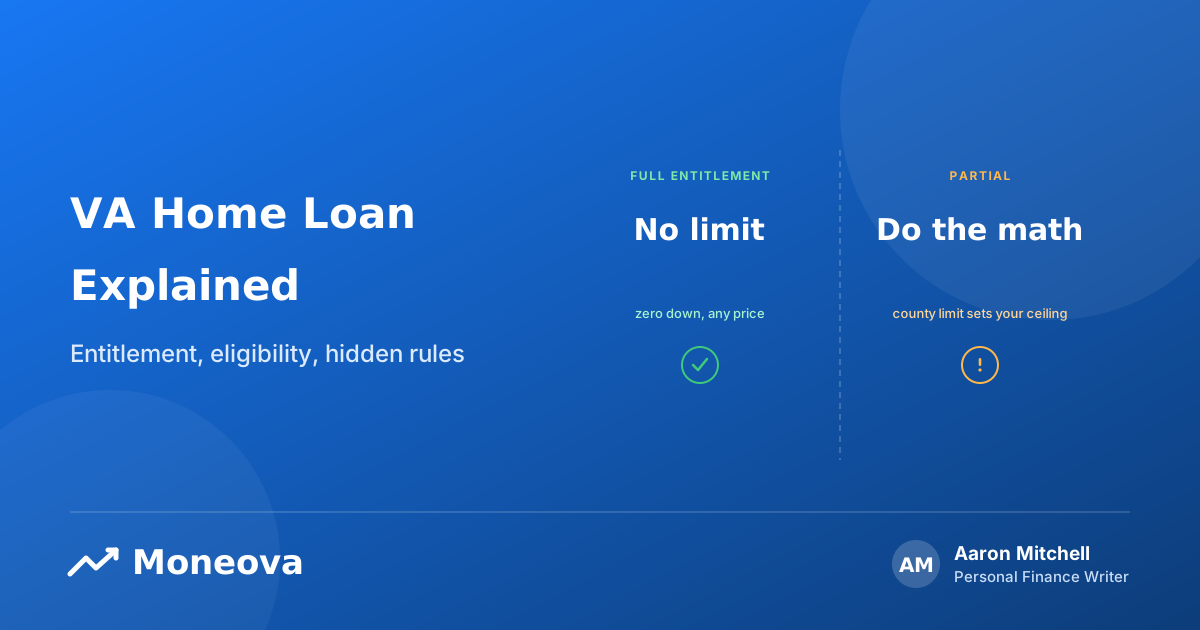
- Full entitlement means the VA places no loan limit on you at all, none, regardless of how expensive the home is. This has been true since a 2020 change eliminated VA loan limits for veterans with full entitlement. You have full entitlement if you've never used a VA loan before, or if you've fully restored it after paying one off.
- Partial entitlement means some of it is tied up in an active VA loan. Here, the county conforming loan limit genuinely matters, and it caps how much you can borrow with zero down.
3. Calculate Your Actual VA Loan Zero-Down Buying Power
Calculating VA entitlement by hand is tedious. Enter your county's loan limit, how much of an existing VA loan is still active (if any), and the home price you're considering.
Enter your county's loan limit, any existing VA loan balance still active, and the home price you're considering.
Illustrative only, not a lending decision. Assumes standard entitlement math; your specific COE and lender may vary. Sources read 22 August 2026.
4. 2026 VA Loan Limits, and When They Actually Apply
For veterans with partial entitlement, VA.gov's own page on home loan entitlement and limits_LINK ties the calculation to the FHFA's conforming loan limits. FHFA's official 2026 conforming loan limit announcement_LINK set the 2026 baseline at $832,750 for most counties, with a high-cost ceiling of $1,249,125, and higher still in Alaska, Hawaii, Guam, and the US Virgin Islands.
These numbers only matter if you have partial entitlement. With full entitlement, there is no VA-imposed ceiling to check against at all.
5. The VA Funding Fee: Rates, and Why It Exists
The same funding fee table applies to a cash out refinance va loan, not just a purchase. The trade-off for no PMI and no down payment is a one-time funding fee, paid at closing or rolled into the loan. It's what makes the whole program self-sustaining without ongoing taxpayer appropriations.
| Down payment | First use | Subsequent use |
|---|---|---|
| Less than 5% down | 2.15% | 3.3% |
| 5% to 9.99% down | 1.5% | 1.5% |
| 10% or more down | 1.25% | 1.25% |
Streamline refinances (IRRRL) run a flat 0.5% regardless of use. VA.gov's page on the funding fee and closing costs_LINK confirms the current rate table took effect April 7, 2023, and is locked through November 14, 2031 by statute, so these figures won't shift year to year the way loan limits do.
The fee is waived entirely for veterans receiving VA disability compensation at any rating, active-duty Purple Heart recipients, and surviving spouses receiving Dependency and Indemnity Compensation. Since 2021, more than half of veterans who got a VA loan qualified for a full exemption. If you have any VA disability rating, checking your exemption status before closing is worth real money.
6. Eligible for a VA Loan? Service Requirements and Your COE
Being eligible for va loan approval comes down to service requirements that differ by component.
- Active duty: 90 continuous days of service.
- Veterans, Gulf War era to present: generally 24 months of continuous service, with exceptions for hardship discharge or a service-connected disability.
- National Guard: 90 days of Title 10 active service, or 90 days of full-time Guard duty including 30 consecutive days, or 6 creditable years.
- Reserves: 90 days of active service, or 6 years in the Selected Reserve.
- Surviving spouses: eligible if the service member was MIA, a POW, or died in service or from a service-connected cause, and the spouse hasn't remarried, or remarried at 57 or older after December 16, 2003.
You prove eligibility with a Certificate of Eligibility. VA.gov's eligibility requirements for the home loan program_LINK confirms lenders can typically pull this electronically in minutes, so you don't need it in hand before you start shopping. Your COE also carries an entitlement code: 00 means full entitlement available, 01 means prior entitlement is charged and partial applies, 05 means previously used entitlement has been fully restored.
7. VA Loans for Manufactured Homes, Condos, and Construction
Property eligibility trips up more VA buyers than almost anything else in the program, mostly because "manufactured," "mobile," and "modular" don't mean the same thing here.
- Manufactured homes, one of the va loans for mobile homes people search for, built on or after June 15, 1976, meeting HUD Code, qualify. A single-wide needs at least 400 square feet, a double-wide at least 700. The home must be permanently affixed to a foundation and titled as real property, not personal property, which rules out homes on leased land in most mobile home parks entirely.
- True mobile homes, built before June 15, 1976, generally do not qualify. That construction date is a hard line, not a guideline.
- Modular homes are the simplest case. Built to local building codes and permanently affixed like any site-built home, they're treated identically to a standard purchase, no special approval category at all.
- Condominiums need to be on the list of va approved condos, the VA's approved project list. This is where VA loans are genuinely stricter than FHA: FHA offers a Single-Unit Approval path that lets an individual unit qualify even when the building itself lacks full approval. VA has no equivalent. If the project isn't approved and can't be approved before closing, VA financing isn't available for that unit, full stop.
- New construction is financeable too, through a VA construction loan, though fewer lenders offer this than standard purchase loans, so shopping specifically for one that does saves real time.
8. A Genuinely New VA Loan Safety Net Most Guides Don't Have Yet
Among va home loan programs, this hardship option is the newest. If you fall behind on payments, what happens changed recently, and it's recent enough that a lot of existing content still describes the old system.
The VA's prior hardship program, the Veterans Affairs Servicing Purchase program, stopped accepting new enrollments on May 1, 2025. In its place, Congress created a permanent VA Partial Claim Program under Public Law 119-31, signed July 30, 2025.
It lets the VA take your missed payments, up to 25% of the unpaid principal balance, and set them aside as a junior lien, so you resume your normal payment instead of facing foreclosure. Servicers only became able to actually submit these partial claims starting June 15, 2026.
If you ever fall behind on a VA loan, this is the tool to ask your servicer about by name.
9. Restoring VA Entitlement, and the Assumption Shortcut Few Know About
Used entitlement isn't gone forever. The standard path is simple: sell the home, pay off the VA loan in full, and your entitlement is restored automatically. You can request it by submitting VA Form 26-1880, or your lender can pull the update electronically, usually within minutes.
There's a less common path that surprises people. If a qualified veteran assumes your existing VA loan and substitutes their own entitlement for yours, your entitlement is released even though you never sold the property and the loan was never paid off.
The assuming buyer doesn't have to be a veteran at all for a standard assumption, they can take over your loan at your existing interest rate. But if you want your own entitlement freed up in the process, the assuming buyer specifically needs to be an eligible veteran willing to substitute their entitlement for yours.
There's also a one-time restoration option for veterans who paid off a VA loan but still own the home, no sale required. This only works once without selling, so it's worth using deliberately rather than by accident on a smaller purchase.
| COE Code | What it means |
|---|---|
| 00 | No prior entitlement used, full entitlement available |
| 01 | Prior entitlement charged, partial entitlement applies |
| 05 | Previously used entitlement has been fully restored |
One situation where restoration gets complicated: foreclosure. The entitlement tied to a foreclosed VA loan generally stays charged, even after the property is gone, unless you repay the VA's claim amount. A foreclosure also typically triggers a two-year waiting period before VA loan eligibility resumes.
10. A Real VA Loan Example: Two Veterans, Two Entitlement Situations
Marcus has never used his VA loan benefit. Priya has an existing VA loan with a $400,000 balance and wants to buy again while keeping her first home as a rental. Both are shopping in the same standard-limit county, 2026 conforming limit $832,750.
| Marcus (full entitlement) | Priya (partial entitlement) | |
|---|---|---|
| Entitlement charged to existing loans | $0 | $100,000 (25% of $400,000) |
| Zero-down ceiling | None, no VA-imposed limit | $432,750 |
| Wants to buy a home for | $900,000 | $500,000 |
| Down payment required | $0 | $16,812.50 (25% of the $67,250 excess) |
Marcus's price tag is nearly double Priya's, and he still puts nothing down, because full entitlement carries no cap. Priya's down payment is real but modest, a fraction of what a conventional loan's 20% would demand on the same excess amount. Our debt-to-income ratio guide covers the separate calculation that determines whether either of them actually gets approved for these amounts in the first place.
11. Frequently Asked Questions
12. Final Thoughts
The VA loan's real value comes from a guaranty mechanic most explanations skip past: the government backs 25% of your loan, and that single number is what makes zero down and no PMI possible in the first place. Entitlement, funding fee tiers, and property eligibility all flow from that one fact.
Before you shop, know whether you have full or partial entitlement, since that changes everything about how much home you can buy with nothing down. And if you're considering anything other than a standard site-built home, confirm the property type qualifies before you fall in love with it, not after.
If a VA loan doesn't end up being the right fit, our FHA vs conventional loan guide covers the two most common alternatives.
This article is for general information only and is not a lending decision or financial advice. Rules and figures described here reflect VA.gov and the FHFA, read 22 August 2026. Loan limits update yearly and funding fee rates are set by statute through November 2031, but individual lender requirements vary; confirm your specific entitlement and eligibility with a VA-approved lender before making an offer. Figures in examples are illustrative, not guarantees of any specific outcome.Disclaimer.