 Banking
ACH vs Wire Transfer Explained: Speed, Cost, and When to Use Each
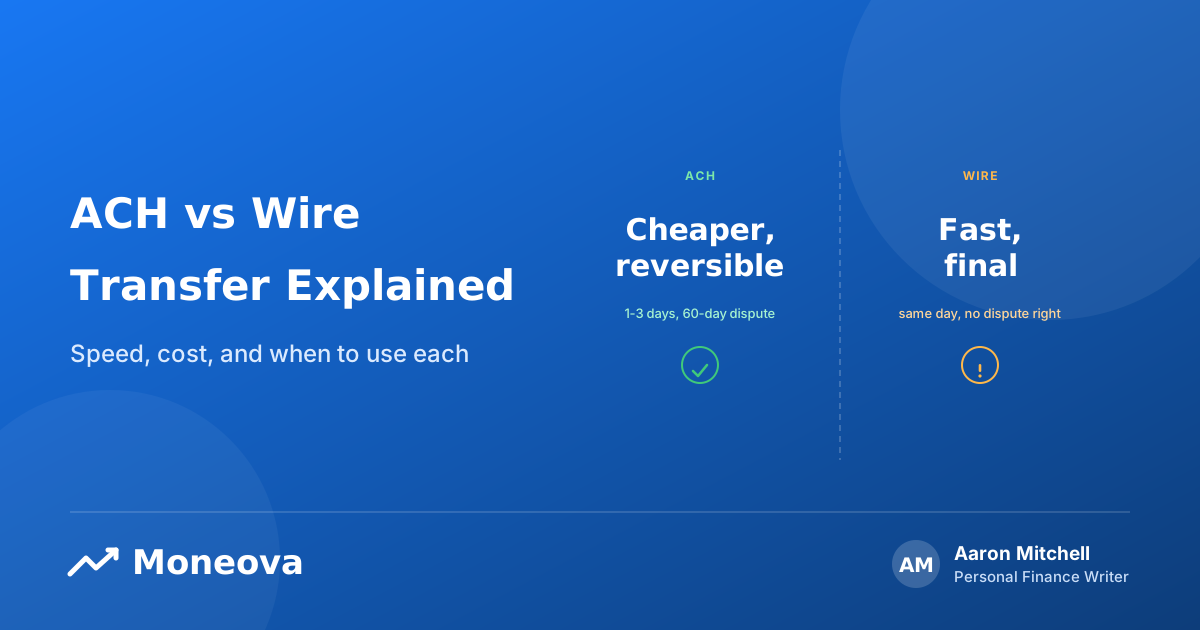
Direct deposit lands in your account. A down payment moves to a title company. A subscription bills you automatically. A large one-time payment to someone new needs to clear today, guaranteed. All of these run through one of two systems, ACH or wire transfer, and most people have no idea which one is handling their money at any given moment, or that the two carry meaningfully different legal protection if something goes wrong.
This article covers what actually decides speed and cost between the two, and the difference that matters more than either: whether the transfer can be undone. It also covers the routing number mistake that causes real wire delays, why scammers specifically ask for wires, and the narrow emergency option that exists if a wire fraud is caught fast enough.
1. What ACH and Wire Transfer Actually Are
Wire transfer vs ACH is one of the most common questions in banking, because ACH (Automated Clearing House) and wire transfer are the two main ways money moves electronically between US bank accounts, and most people use both without knowing which one they are using. Direct deposit of your paycheck, autopay on a bill, and a Venmo or Zelle transfer to a friend all run on the ACH network. A down payment sent to a title company, or a large one-time payment to someone you do not have an ongoing relationship with, is more often a wire.
The core difference is how the money actually moves. A wire transfer vs bank transfer question usually means the same thing as wire vs ACH, since "bank transfer" is commonly used as an umbrella term covering both.
- ACH batches transactions together and processes them at set times during the day, through a national clearing network. It is built for volume: billions of transactions a year, most of them small.
- A wire transfer moves one transaction at a time, directly bank to bank, usually settling the same day, sometimes within minutes. It is built for speed and finality on large, one-off payments.
The scale difference between them is stark. Nacha reported the ACH network moved 35.2 billion payments worth $93 trillion in 2025, an average of a few thousand dollars per payment. Fedwire, which settles the majority of US wire transfers, handled roughly 199 million transactions in the same period at an average value of about $5.3 million each, a figure pulled up by large interbank and corporate settlements. That gap is not a coincidence, it reflects what each network was actually designed to do.
2. Speed and Cost: What Actually Changes
An ACH wire transfer comparison, or ACH wire payment question, usually starts here. Both dimensions matter less in isolation than most comparisons suggest, because the real difference is timing certainty, not just the number of days.
| ACH | Wire transfer | |
|---|---|---|
| Standard speed | 1 to 3 business days | Same business day, often within hours |
| Faster option | Same-Day ACH, for a fee | Already same-day by default |
| Typical cost, consumer | Often free, or a small flat fee | $15-$50 outbound, $0-$15 inbound |
| International reach | Domestic only, with limited exceptions | Global, via SWIFT for cross-border |
| Direction | Can push or pull funds | Push only, sender-initiated |
Which is faster ACH or wire transfer has a consistent answer: a wire, in nearly every case. Same-Day ACH exists and is widely available, but it still runs through scheduled clearing windows during the day rather than settling the instant you send it, and most banks charge extra for it. A wire sent before your bank's cutoff time, typically mid-afternoon, is usually confirmed the same day without needing to request anything special.
The direction difference matters more than it sounds. ACH can pull money, which is how autopay and subscription billing work: the biller initiates the request and your bank sends the funds. A wire only pushes: only you, the sender, can initiate it, which is part of why wires are used for payments where the sender needs to control exactly when money moves.
3. The Difference That Matters Most: Can It Be Undone
An ACH payment vs wire comparison almost always leads with speed and cost. The distinction that actually decides how much risk you are taking on is reversibility, and it is where the two systems genuinely diverge.
ACH transfers are different. If an ACH debit hits your account that you did not authorize, the full text of Regulation E, 12 CFR Part 1005 gives you the right to dispute it, and your liability is capped by law provided you report it within the required window. The CFPB's electronic fund transfer FAQs sets out exactly how that process works.
Two separate ACH timelines get conflated constantly. The 60-day window above covers unauthorized transactions you are disputing under Regulation E. A different, shorter mechanism exists for the bank's own processing mistakes: Nacha operating rules give banks up to 5 business days to reverse an ACH entry sent in error, such as a duplicate payment, the wrong amount, or the wrong account, and 2 business days for certain NSF-related returns. These are not the same right, do not run on the same clock, and knowing which one applies to your situation matters when something goes wrong.
A wire sent in error, or sent because you were deceived by a scammer, has no equivalent federal consumer-protection backstop. Once a wire clears, which can happen within minutes, it is generally final. There is a narrow window to act before that: contacting your bank immediately, often within minutes to a couple of hours, can sometimes stop a wire before the receiving bank credits the funds, but this is a courtesy the sending bank attempts, not a right you can enforce, and it closes fast. Recovery after that point depends on the receiving bank's willingness to return funds voluntarily, which it has no legal obligation to do, or on a narrow emergency mechanism covered in section 8.
3.1 Wires fall under a different law entirely
Excluded from Regulation E, wire transfers are instead governed by UCC (Uniform Commercial Code) Article 4A, a model law adopted in nearly identical form by all 50 states. Under Article 4A, if your bank used a "commercially reasonable" security procedure to verify the wire, and the wire was processed in good faith, the bank can generally hold you responsible for a fraudulent wire even though you never authorized it, unless you can prove the fraud did not originate through your own compromised credentials. That is a materially harder standard to clear than simply reporting an error within 60 days.
One unsettled wrinkle worth knowing: a federal district court in the Southern District of New York broke from the general rule in a 2024-2025 case, suggesting the consumer-facing portion of a wire initiated through online banking might fall within EFTA's (Electronic Fund Transfer Act's) scope after all. This is not the mainstream legal position as of this writing, and most courts still follow the straightforward exclusion, but it signals the law in this area is not fully settled.
4. What Major Banks Actually Charge, and What Gets Reported
Posted fee schedules vary bank to bank and change over time, but the major US banks cluster in a predictable range.
| Bank | Domestic wire, online | International wire, online | Incoming wire |
|---|---|---|---|
| Chase | $25 | $40-45 | $0-15 |
| Bank of America | $30 | $45 | $0-16 |
| Wells Fargo | $25-30 | $45 | $0-16 |
Fees quoted here reflect published 2026 online rates and are illustrative; confirm the current fee schedule directly with your bank before sending, since branch-initiated wires typically cost more and premium account tiers often waive the fee entirely. International wires carry an additional cost that rarely appears as a line item: an exchange-rate markup, commonly 2 to 5 percent above the mid-market rate, which on a modest transfer can exceed the flat fee itself.
3.1 The $10,000 reporting myth
A common belief is that any wire transfer over $10,000 gets automatically reported to the IRS. That is not accurate, and conflates two separate rules. The $10,000 threshold that triggers automatic reporting, a Currency Transaction Report, applies specifically to physical cash transactions, not electronic wires or ACH payments.
What actually applies to electronic transfers is a lower, different threshold: under the Bank Secrecy Act's recordkeeping and Travel Rule requirements, banks must retain detailed records, sender and recipient information, for any wire transfer of $3,000 or more. That is a recordkeeping obligation, not an automatic report to a government agency; the records sit at the bank unless a regulator or investigator requests them. Separately, a bank can file a confidential Suspicious Activity Report on a transaction of any size, with no minimum dollar threshold, if the activity looks unusual, a judgement call made by the bank rather than a fixed rule.
5. Work Out Which One Fits Your Transfer
Answer a few questions about the transfer you are actually making, and this will point you toward whichever network fits better, along with what to expect on cost and timing.
Answer a few questions about the transfer you are making. This points you toward ACH or wire, and flags what to expect on cost, speed, and reversibility.
Illustrative guidance only, not financial advice. Actual availability of Same-Day ACH, wire cutoff times, and fees vary by bank. Sources read 13 August 2026.
6. Is ACH the Same as EFT? Untangling the Terms
An ACH transfer vs wire transfer mix-up is common because ACH, EFT (Electronic Funds Transfer), and wire transfer get used almost interchangeably in casual conversation, and the confusion is understandable because the terms genuinely overlap rather than sitting side by side.
ACH vs EFT is really a category-versus-member question, not two competing systems.
Apps like Zelle add another layer of confusion, because a Zelle payment looks and feels instant, but the money actually moves through the ACH network behind the scenes, using a private, faster-settling arrangement between participating banks rather than the standard multi-day ACH clearing schedule. It is still ACH, not a wire, and not a separate payment rail of its own.
7. Why Your Wire Might Bounce: The Routing Number Trap
An ACH deposit vs wire transfer, on the receiving end, usually differs in exactly this way. This catches more people than almost anything else in this article. Many banks use a different routing number for wire transfers than the one printed on your checks and used for ACH.
The routing number on a check is built for the ACH network. Larger banks in particular often route wires through a separate department, or even a separate processing bank entirely, with its own distinct routing number. Using your everyday ACH routing number on a wire form can cause the transfer to be delayed, rejected, or in rarer cases misdirected.
Before sending or receiving a wire, check your bank's specific wire instructions, usually available in online banking under a heading like "wire transfer details," rather than assuming the number on a check will work. This single detail causes a meaningful share of the wire delays banks report.
8. Why Scammers Specifically Ask for a Wire
The reversibility gap described in section 3 is not an abstract legal technicality. It is the exact reason wire transfers are the payment method scammers request most often, and the people targeted hardest by this are older Americans.
The pattern behind those numbers is consistent: a scammer posing as a grandchild, a government agency, or a romantic interest creates urgency and specifically requests a wire transfer, because unlike a credit card charge or an ACH payment, there is no simple 60-day dispute right waiting on the other end. Once the money lands and moves on, it is usually gone.
7.1 The narrow emergency option, and why it rarely helps
A mechanism called the Financial Fraud Kill Chain, coordinated through FinCEN (the Financial Crimes Enforcement Network) and the FBI, can sometimes freeze a fraudulent international wire before it is fully disbursed. It is genuinely effective when it applies, with a strong recovery rate in past fiscal years. It is also narrow: it generally applies only to international wires of $50,000 or more, reported within about 72 hours.
Most elder fraud wires do not qualify. Of 201,266 elder fraud complaints reported to IC3 in 2025, only a small fraction, in the low hundreds, were reported quickly enough and met the size and international threshold to enter the freeze process at all. For a domestic wire, or one under $50,000, or one reported after a few days have passed, this safety net generally does not exist.
If a wire fraud is suspected, contact your bank's fraud department immediately, before doing anything else, and ask specifically whether a recall or the Financial Fraud Kill Chain applies. Minutes matter far more with a wire than with almost any other kind of payment.
9. A Real Example: Same Mistake, Two Different Outcomes
Numbers make the reversibility gap concrete. Grace and Tom each accidentally send $4,000 to the wrong account, Grace via ACH, Tom via wire, both discovered the next morning.
| Grace, sent by ACH | Tom, sent by wire | |
|---|---|---|
| Amount | $4,000 | $4,000 |
| Governing protection | Regulation E | UCC Article 4A |
| Dispute window | 60 days from the statement | No equivalent federal window |
| Bank's obligation to help | Legally required to investigate and resolve | Recall request only; receiving bank can decline |
| Likely outcome | Funds recovered through the dispute process | Recovery depends entirely on the other bank's cooperation |
Same mistake, same amount, same discovery time, and a fundamentally different set of odds, purely because of which network carried the payment. This is exactly why the choice between ACH and wire matters even when nothing goes wrong with the recipient: the protection you are giving up is invisible until you need it.
10. When to Use Each One
- For an ACH payment vs wire transfer decision on a recurring bill, use ACH. It fits payroll, recurring bills, subscriptions, and payments to people or businesses you have an ongoing relationship with. It is cheaper, and Regulation E's protections apply. If a scheduled ACH payment ever overdraws your account, our guide to overdraft fees covers what happens next.
- Use a wire for real estate closings, large one-time payments to someone you are transacting with for the first time, and anything genuinely time-sensitive where same-day, guaranteed finality matters more than cost.
- Before sending any wire, verify the recipient's details through a second channel you trust, such as a phone call to a known number, never a number provided in the same message requesting the wire.
- Double-check the routing number is the wire-specific one, not the one printed on a check, per section 6.
- Treat a wire request accompanied by urgency or secrecy as a warning sign, regardless of who appears to be asking. Legitimate closings and business transactions rarely require same-hour action with no verification.
The Federal Reserve Financial Services page on wire transfers and Federal Reserve's overview of the Fedwire Funds Service cover the mechanics of how wires actually clear through the Federal Reserve system, and the FTC consumer guide to credit, loans and debt is a useful starting point for consumer protection topics more broadly.
11. Frequently Asked Questions
12. Final Thoughts
The number people fixate on when comparing ACH and wire transfer is cost, sometimes speed. The number that actually matters most is reversibility, and it is the one dimension where the two systems are not just different in degree but different in kind: one carries a federal consumer dispute right, the other does not, regardless of whether the transfer is personal or business.
Before sending a wire, especially a large one to someone new, treat that irreversibility as the default assumption rather than an edge case. Verify the recipient through a second channel, confirm the correct wire routing number, and be skeptical of any request paired with urgency. That habit costs a few extra minutes and closes most of the gap the two systems otherwise leave open.
This article is for general information only and is not financial or legal advice. The legal distinctions described here, including the scope of Regulation E and UCC Article 4A, reflect federal law and case law read on 13 August 2026, including the Fifth Circuit's January 2025 decision; an unsettled minority position on consumer-initiated electronic wires from at least one federal district court is noted where relevant, but is not the general rule. Bank-specific fees, cutoff times, and wire recall procedures vary and should be confirmed directly with your bank. Figures in examples are illustrative, not quotes. If you suspect wire fraud, contact your bank's fraud department immediately.Disclaimer.