 Banking
Overdraft Fees Explained: What They Cost and How to Avoid Them
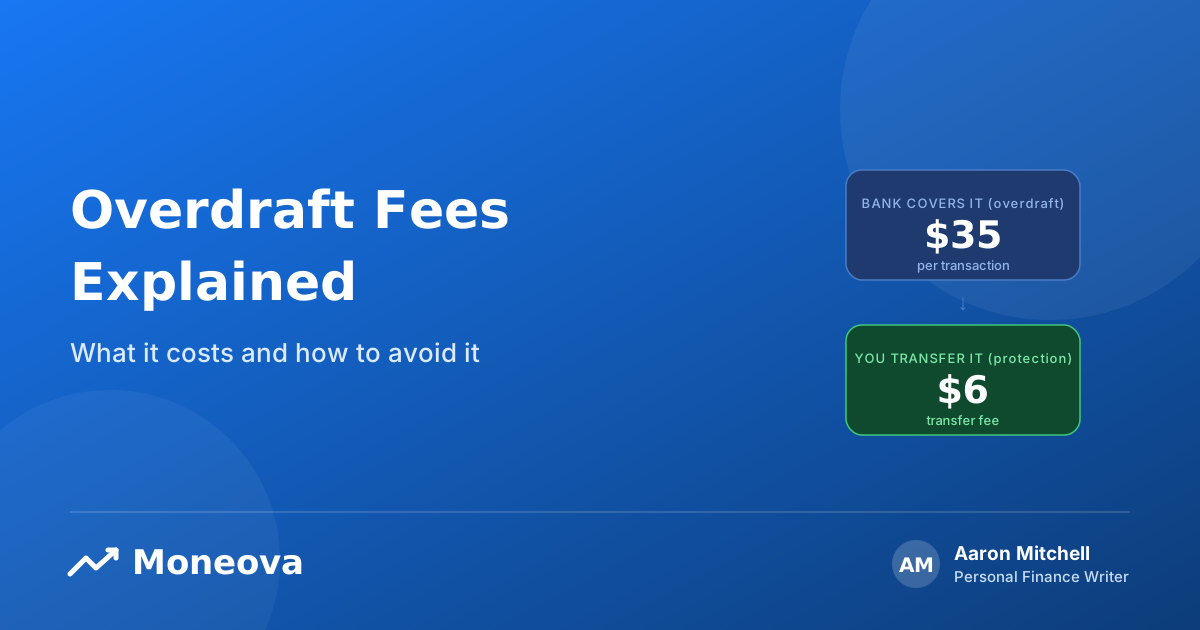
The average overdraft fee is around $35. The average overdraft amount, the actual gap between what you had and what you spent, is closer to $24. So banks routinely charge more for covering a shortfall than the shortfall itself.
That arithmetic would be hard to justify as a business model, except for one thing: most people who pay overdraft fees on their debit card agreed to it. Not in any conscious sense, but by ticking a box in account-opening paperwork years ago, probably without reading it, probably without knowing what they were signing away.
A federal rule since 2010 says banks cannot charge that fee on everyday debit card and ATM transactions without your consent. It also says you can withdraw that consent at any time. Most people have never been told.
1. What an Overdraft Fee Actually Is
An overdraft, and the meaning of overdraft is simply drawing more than you have, happens when you spend more money than your account holds and your bank pays the transaction anyway. The overdraft fee is what the bank charges you for doing that.
What makes it unusual is the sequence. The fee is not charged because you did something wrong. It is charged because the bank chose to cover the shortfall rather than decline the payment, and then charged you for the favour. Whether that choice was made with your knowledge or not is the subject of most of this article.
- The typical fee is around $35 per transaction, though it varies by bank. Some charge nothing at all.
- It can happen multiple times in one day. Many banks cap the number of overdraft fees per day, but not all, and the cap can still be three, four or five separate charges.
- Small purchases trigger it just as much as large ones. A $4 coffee can produce a $35 fee if the timing is wrong.
- An overdraft fee is different from an NSF fee, even though both relate to insufficient funds. The distinction matters and is covered in section 3.
- Federal law limits when banks can charge it for debit and ATM transactions, and you may have the right to stop them. Most people do not know this.
2. The Opt-In Rule Almost Nobody Knows They Triggered
In 2010 a federal rule changed the landscape for overdraft fees on debit card and ATM transactions, and most consumers missed it entirely.
Under Regulation E, a federal rule on electronic fund transfers, banks cannot charge an overdraft fee on a one-time debit card purchase or ATM withdrawal unless you specifically asked them to. The technical term is opting in to overdraft coverage, and without that opt-in the bank is required to simply decline the transaction at the point of sale instead.
Here is where it goes wrong for most people. Banks were allowed to ask customers to opt in, and the question was usually buried in account-opening paperwork. Millions of people opted in without understanding what they were agreeing to, and are now paying $35 per transaction for a service they never consciously chose.
| Transaction type | Can the bank charge an overdraft fee without your opt-in? |
|---|---|
| One-time debit card purchase | No |
| ATM withdrawal | No |
| Cheque or paper payment | Yes |
| Automatic bill payment (ACH) | Yes |
| Recurring debit card payment set up in advance | Yes |
The divide in that table is important. The 2010 opt-in rule covers one-time transactions. It does not cover cheques, automatic bill payments or recurring debit transactions, so even if you opt out, overdraft fees can still be charged on those. Automatic bill payments typically run through the ACH network; our guide to ACH vs wire transfer covers how that differs from a one-time debit or wire. The text of Regulation E section 1005.17 on overdraft services sets out the rule in full.
2.1 How to Opt Out of Overdraft Coverage
To opt out of overdraft, sometimes written as opt out overdraft coverage, call or write to your bank and tell them you want to opt out of overdraft coverage for debit card and ATM transactions. You can do this at any time, with no penalty. The bank must give you a reasonable time to act on the change, and cannot charge you a fee for opting out.
After opting out, the practical experience changes. A debit transaction that would overdraw the account is declined at the terminal. This can be embarrassing in the moment, but it costs nothing, whereas a $35 fee costs $35.
3. The $5 Cap That Almost Happened, and Why It Did Not
In December 2024, the Consumer Financial Protection Bureau finalized a rule that would have capped overdraft fees at large banks, those with more than $10 billion in assets, at $5 per overdraft, unless the bank could show a higher fee reflected its actual costs, or chose to treat overdraft coverage as a loan subject to Truth in Lending Act disclosures. The rule was set to take effect 1 October 2025.
It never did. Congress used the Congressional Review Act, a fast-track procedure that lets a simple majority overturn a federal agency rule, to block it. The Senate voted 52 to 48 on 27 March 2025. The House followed on 9 April 2025. President Trump signed the resolution on 9 May 2025, five months before the cap was due to take effect.
The financial scale of that decision is not abstract. Bank overdraft and non-sufficient funds fee revenue, which had been declining under regulatory pressure, climbed back above $12 billion annually by mid-2026, reversing what the CFPB had projected as roughly $5 billion a year in consumer savings had the cap taken effect, an estimated $225 per affected household annually.
None of this changes the opt-in rule described above, which is a separate, older protection that survived intact. What it does mean is that if you are counting on a federal cap to limit what a fee can cost you, that protection does not currently exist. The fee your bank charges today is the fee that applies, and it can be $34, $35, or $36 depending on the bank, with no legal ceiling forcing it lower.
4. Overdraft Fee vs NSF Fee: Two Charges for Nearly the Same Event
These two fees cause more confusion than almost anything else in personal banking, because they involve the same starting situation, a payment you do not have enough money to cover, but produce opposite outcomes.
| Overdraft fee | NSF fee | |
|---|---|---|
| What NSF stands for | Not applicable | Non-sufficient funds |
| What the bank does | Pays the transaction anyway | Declines or returns the payment |
| What happens to the payee | Receives the money | Does not receive the money, may charge a returned-item fee |
| Typical fee | Around $35 | Around $35 |
| Leaves a negative balance? | Yes | No |
| Covered by the 2010 opt-in rule? | Partly (debit/ATM only) | No |
Both charge you roughly the same amount. The difference is that an overdraft fee lets the payment go through, which protects you from the payee's consequences but leaves your account negative. An NSF fee stops the payment and your account stays at zero, but the payee, a landlord, a utility company, a lender, may charge their own returned payment fee on top.
For a cheque that bounces, a returned cheque can trigger a fee from your bank and a returned-item fee from the payee, making it potentially more expensive than an overdraft, not less. The CFPB answer on non-sufficient funds fees explains what an NSF fee is and when it applies.
5. Overdraft Protection: The Third Option People Do Not Know Exists
Between paying $35 to have a payment go through and having it declined outright is a middle option: overdraft protection, which automatically transfers money from a linked account to cover a shortfall.
| Type | How it works | Typical cost |
|---|---|---|
| Linked savings account | Bank moves money from your savings to cover the gap | $0 to $12 per transfer |
| Linked credit card | Bank charges the shortfall to your credit card | $0 to $10, plus card interest if not paid off |
| Overdraft line of credit | Small credit line attached to the account | Interest on the amount borrowed |
| Standard overdraft service | Bank pays it and charges a fee | Around $35 per transaction |
Banks often call this OD protection, short for overdraft protection, and it is a separate product from standard overdraft coverage. A transfer from a linked savings account is almost always cheaper than standard overdraft. The catch is that you have to set it up before you need it, and many banks do not explain it prominently. If you have a savings account at the same bank as your current account, it is worth asking whether the link can be set up at no recurring cost.
The credit line option carries interest but avoids the flat fee structure that makes overdraft expensive on small transactions. Paying 18% annual interest on a $20 shortfall for one week costs about seven cents, against the $35 flat fee.
For more on how checking and savings accounts work together, our guide to the difference between checking and savings accounts covers the account types.
6. What Overdraft Fees Actually Cost Over a Year
The individual fee rarely looks like the problem. The pattern does.
| Scenario | Annual cost |
|---|---|
| One overdraft per year at $35 | $35 |
| One per month at $35 | $420 |
| Two per month at $35 | $840 |
| Three per month at $35 | $1,260 |
FDIC data shows that a small share of accounts, roughly 8% of customers, pay the majority of all overdraft fees, and that most of those accounts belong to people with lower incomes and lower average balances. For that group the fee is not occasional. It is a recurring monthly expense that compounds a shortfall rather than solving it.
The FDIC consumer news on overdraft and account fees has data on overdraft practices and how they affect different groups of consumers.
There is also an effective interest rate calculation that puts the fee in context. An overdraft of $20 covered for five days at a $35 fee has an annualised cost of over 6,000%. The number is almost meaninglessly large, but it illustrates why the flat fee structure of overdraft is described by regulators as more expensive than a credit card or a payday loan for small, short-term shortfalls.
7. Work Out What Overdraft Fees Cost You
The individual $35 charge is easy to shrug off. Over a year it is harder to. Put your own numbers in below and this works out the annual cost, what a linked savings account transfer would have cost instead, and how much you would save by opting out and accepting declines.
Enter your typical pattern and this works out the annual cost of standard overdraft, what a linked savings transfer would have cost instead, and the saving from opting out of coverage for debit and ATM transactions.
Illustrative only, not financial advice. Overdraft fees vary by bank and account type. The opt-in rule under Regulation E covers one-time debit card and ATM transactions; it does not cover cheques, automatic bill payments or recurring debit transactions, so opting out does not eliminate all overdraft fees. Sources read 10 August 2026.
8. How to Avoid Overdraft Fees
In order of how much effort each takes:
- Opt out of standard overdraft for debit and ATM transactions. One phone call, no fee, and the bank must process it. After opting out a declined transaction costs nothing. This does not help for cheques or bill payments.
- Set up overdraft protection with a linked account. A transfer fee of $0 to $12 instead of $35, and the payment goes through. Works for all transaction types, not just debit and ATM.
- Turn on low-balance alerts. Most banking apps can send a text or notification when the balance drops below an amount you choose. A $50 threshold gives you time to act.
- Keep a small buffer. Treating the real zero as $50 or $100 above the actual zero removes the margin for error. Some people label this amount "not real money" in their mental accounting.
- Check your balance before large purchases. Takes ten seconds and costs nothing.
- Consider a bank with no overdraft fees. A number of banks and credit unions have eliminated the fee entirely, covering shortfalls either for free or by declining without a charge. Our guide to opening a bank account covers what to look for.
- Check whether you are eligible to have a fee waived. Banks will sometimes waive a first-time overdraft fee if you ask, and some waive fees for students, military members or customers in good standing. It takes a phone call.
9. What Happens If Your Account Stays Negative
An overdraft leaves your balance below zero, and ignoring it creates a second set of problems beyond the initial fee.
- Additional overdraft fees. Any further transactions that go through while the account is negative can each trigger another fee.
- Extended overdraft fees. Some banks charge an additional fee for each day the account remains negative beyond a grace period.
- Account closure. If a negative balance is not repaid, the bank can close the account and send the balance to collections.
- ChexSystems report. Banks share information about accounts closed in bad standing through a consumer reporting agency. A negative ChexSystems record can make it difficult to open another current account for up to five years, which is why people in this situation sometimes struggle to find banking at all.
- Collections and credit impact. If the balance goes to a collections agency, it can appear on your credit report as an unpaid debt.
The practical priority, if your account is negative, is to deposit money to bring it back above zero as quickly as possible, starting with the most recent overdraft. Call the bank to ask about a repayment plan if the amount is large. Most banks prefer that conversation to writing off a balance.
If debt has already gone to collections, our guide to building credit from scratch covers what that means for your report and what the realistic timeline looks like for recovery.
10. A Real Example: Two Accounts, One Shortfall
Numbers make the difference concrete. Marcus and Priya each have a $10 shortfall in their account on Tuesday morning. The shortfall is caused by a $150 rent auto-payment going out before a $160 paycheck arrives on Wednesday.
| Marcus | Priya | |
|---|---|---|
| Account setup | Opted into standard overdraft, no linked savings | Linked savings account set up, opted out of standard overdraft for debit |
| The auto-payment goes through? | Yes, bank covers it | Yes, bank transfers from savings |
| He buys a $4 coffee with his debit card | Goes through, second overdraft fee | Declined at the terminal |
| He uses the ATM for $20 | Goes through, third overdraft fee | Declined |
| Cost by Wednesday when pay arrives | $105 in overdraft fees on a $10 shortfall | $6 transfer fee |
The $10 shortfall was identical. The $99 difference came from two choices Marcus made at account opening, probably in under thirty seconds, that he almost certainly does not remember.
The auto-payment would have triggered an overdraft fee for both of them regardless, because recurring ACH payments are not covered by the opt-in rule. The difference is the $4 coffee and the ATM withdrawal: neither would have generated a fee for Priya because she had opted out, and a simple decline protected her without any cost.
11. Your Rights, and What to Do If a Fee Is Wrong
The 2010 opt-in rule is law, not a bank policy. If your bank charges you an overdraft fee on a one-time debit card or ATM transaction without having obtained your opt-in consent, the fee was charged in violation of federal law.
- Ask the bank to reverse it. Call and explain you were not informed of the opt-in requirement, or that you opted out and the transaction should have been declined. Banks reverse fees in this situation regularly.
- File a complaint with the CFPB. The CFPB consumer tools for bank accounts has the tools to submit a complaint. The bureau forwards it to the bank, which must respond.
- Contact your state attorney general or banking regulator if the bank does not resolve it. State regulators have authority over state-chartered banks.
For any overdraft fee, regardless of whether there is a legal violation, it is worth simply calling and asking for a refund. First-time waivers are common and many banks will waive one fee per year for an account in good standing. The worst answer is no, which leaves you where you already are.
Frequently Asked Questions
Final Thoughts
The $35 fee rarely feels like a decision that was made. It usually feels like something that just happened. But the opt-in that enabled it was a decision, made at account opening, probably buried in a form, and it is a decision you can reverse today.
Call your bank and opt out of overdraft coverage for debit and ATM transactions. Then ask whether a linked savings account can be set up for the transactions the opt-in rule does not cover. Those two steps, one phone call each, cover most of what this article describes. Neither costs anything, and neither closes your account or removes any other benefit. The worst that happens after opting out is a declined transaction at a terminal, which is embarrassing but free.
This article is for general information only and is not legal or financial advice. Overdraft rules described here are based on Regulation E section 1005.17, read on 10 August 2026; federal rules can change and individual bank policies vary. The opt-in rule covers one-time debit card and ATM transactions; it does not cover cheques, automatic bill payments or recurring debit transactions. FDIC and NCUA insure deposits at member banks and credit unions within standard limits. Dollar figures are illustrative examples, not quotes. Check with your bank or a qualified adviser for your own situation.Disclaimer.