 Banking
What Is an HSA? How Health Savings Accounts Work and Who Qualifies
Somewhere in the open enrolment paperwork is an option called an HSA, described in a sentence that assumes you already know what it is. Most people skip it, pick the plan with the lower deductible, and never think about it again.
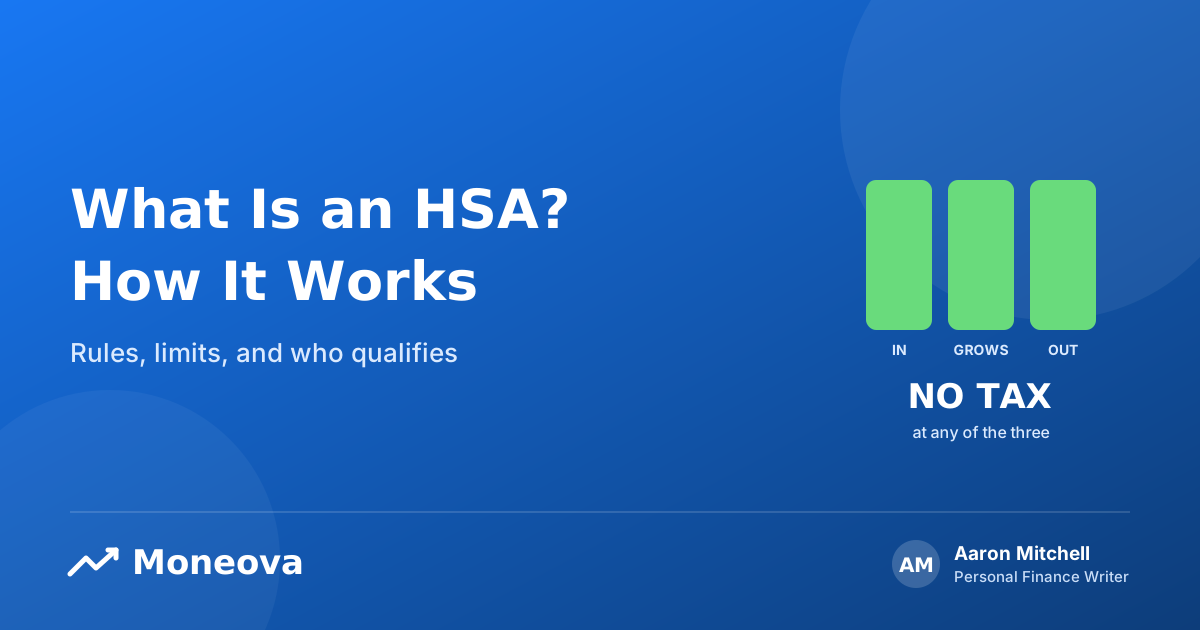
That is a reasonable choice for some people and an expensive one for others, and the difference is worth about a thousand dollars a year to a household in the middle. An HSA is the only account in the American tax code where money goes in untaxed, grows untaxed, and comes out untaxed. Not one of those three, all of them.
The catch is that you have to hold a specific kind of health plan to open one, and the test for whether your plan qualifies has two halves. Nearly every guide explains only the first, which is why people contribute for a year before discovering they were never eligible.
1. What a Health Savings Account Actually Is
A health savings account, almost always shortened to HSA, is a savings account with unusual tax rules, meant for medical costs. You put money in, it sits there, and you spend it on healthcare. The reason it gets so much attention is what happens to the tax at each stage.
Start with what it is not, because the confusion is common enough to have its own search traffic. People type "HSA insurance" and "HSA health insurance" into Google every month, and neither is a real product. An HSA is not insurance. It does not pay a claim, it has no network, and it covers nothing on its own. It is a bank account with a tax wrapper. The insurance is a separate thing you must already have in order to open one, which is the subject of section 3.
- The money is yours permanently. Not an allowance, not a benefit. It stays with you when you change job, change insurer, or retire.
- Nothing expires. Unspent money rolls into next year and every year after it, indefinitely.
- You can invest it. Most providers let you move the balance beyond cash into funds once it passes a threshold, which is what separates it from an ordinary high-yield savings account.
- You need a specific type of health plan to open one. This is the condition that stops most people, and it is stricter than it looks.
- There is an annual cap on what you can put in. Set by the IRS and adjusted most years.
2. The Triple Tax Break, and Why It Is Genuinely Unusual
Most tax-advantaged accounts give you a break at one end or the other. A traditional retirement account gives it going in and taxes you coming out. A Roth account taxes you going in and lets withdrawals out free. An HSA does both, and skips the tax on growth in between.
| Stage | Traditional IRA | Roth IRA | HSA |
|---|---|---|---|
| Money going in | Not taxed | Taxed | Not taxed |
| Growth inside | Not taxed | Not taxed | Not taxed |
| Money coming out | Taxed | Not taxed | Not taxed, for medical costs |
That third column is why financial writers get excited about a health account. There is no other account with all three, and the conditions on the third row are broader than people expect: qualified medical expenses cover far more than doctor visits.
Two details that make the break bigger than the table suggests:
- Contributions through payroll also avoid payroll tax. Money routed from your salary into an HSA by your employer escapes Social Security and Medicare tax as well as income tax. Contributing your own money separately and claiming the deduction later gets you the income tax break but not this one.
- There is no deadline to reimburse yourself. Pay a medical bill from your own pocket today, keep the receipt, and you can take that amount out of the HSA tax-free in twenty years. The money compounds in the meantime.
The IRS overview page for Publication 969 is the starting point for how this tax treatment is set out in the rules.
3. Who Qualifies: The Bracket Nobody Explains Properly
You cannot simply decide to open an HSA. You have to be covered by a qualifying high deductible health plan, usually shortened to HDHP, which is a health plan that trades a lower monthly premium for a larger amount you pay yourself before cover starts, and which meets specific IRS thresholds.
Here is where nearly every article goes wrong. They say you need a plan with a high deductible, quote the minimum, and stop. That is only half the test.
| 2026 requirement | Self-only cover | Family cover |
|---|---|---|
| Deductible must be at least | $1,700 | $3,400 |
| Out-of-pocket maximum must not exceed | $8,500 | $17,000 |
Both conditions, not either. Check both numbers on your plan's Summary of Benefits and Coverage before assuming you are eligible, and check them again at open enrolment, because plans change their cost sharing year to year and a plan that qualified last year may not this year.
Beyond the plan itself, four other conditions apply. You must not be covered by any other health plan that is not an HDHP, you must not be enrolled in Medicare, you must not be claimed as a dependent on someone else's tax return, and you generally must not have a general-purpose health flexible spending account, including through a spouse's employer.
That last one catches couples. A spouse's general-purpose flexible spending account can disqualify you even though it is not your account and you never use it, because it is treated as giving you other first-dollar coverage. The IRS Publication 969 on health savings accounts is the authoritative source on all of these conditions.
4. How Much You Can Put In
The IRS sets the annual maximum and adjusts most of it for inflation each year, publishing the figures by 1 June for the year ahead.
| 2026 limit | Amount |
|---|---|
| Self-only cover | $4,400 |
| Family cover | $8,750 |
| Catch-up, age 55 and over | $1,000 on top |
Three rules about that cap decide more than the number does:
- Employer contributions count against your limit. If your employer puts in $1,000 and you have self-only cover, you can add $3,400, not $4,400. This is the single most common way people overcontribute by accident.
- Overcontributing is penalised. Excess money left in the account attracts a 6 percent excise tax for every year it stays there, so the fix is to withdraw it, with any earnings on it, before the tax deadline.
- The catch-up is per person, not per account. A married couple both over 55 can each add $1,000, but they need two accounts to do it, because an HSA cannot be jointly owned.
4.1 The catch-up figure that has not moved since 2009
The contribution limits above rise most years with inflation. The $1,000 catch-up does not, because it is fixed in statute rather than adjusted by the IRS, and it has been $1,000 since 2009.
That matters more than it sounds. Everything else in this article inflates annually; this one number has stood still for seventeen years while the cost of the healthcare it is meant to fund has not. It is the provision aimed at savers closest to retirement, and it is the one quietly shrinking in real terms every year.
The IRS revenue procedure setting the 2026 contribution and plan limits is the primary source for the 2026 figures, published in May 2025 and effective from 1 January 2026.
5. HSA vs FSA: The Difference That Costs People Money
A flexible spending account, or FSA, is the other pre-tax medical account, and the two get confused constantly because both let you pay for healthcare with untaxed money. Beyond that they behave almost oppositely.
| HSA | FSA | |
|---|---|---|
| Who owns it | You | Your employer |
| What happens at year end | Rolls over, forever | Largely forfeited, with limited exceptions |
| If you leave the job | Goes with you | Usually stays behind |
| Can you invest it? | Yes, at most providers | No |
| Requires a specific health plan? | Yes, an HDHP | No |
| Can you change contributions mid-year? | Yes | Rarely, only on qualifying events |
| Available without an employer? | Yes | No |
The row that costs real money is the second one. FSA money left at year end is generally forfeited, which is why people spend December buying things they do not need. HSA money has no deadline at all.
The row that catches people out is the fifth. Because a general-purpose FSA counts as other coverage, having one disqualifies you from contributing to an HSA, and a spouse's FSA can do the same. If you have the choice and you qualify for an HSA, the HSA is almost always the better account. The exception is when you do not qualify at all, in which case an FSA is better than nothing.
6. What You Can Spend It On
Qualified medical expenses are defined by the IRS, and the list is wider than most people use it for.
- The obvious ones: doctor visits, hospital care, surgery, prescriptions, and your deductible and copayments.
- Dental and vision: check-ups, fillings, braces, glasses, contact lenses, and laser eye surgery.
- Things people forget: therapy and mental health treatment, chiropractic care, physiotherapy, and smoking cessation programmes.
- Over-the-counter items: pain relief, allergy medicine, first aid supplies, period products, and sunscreen.
- Some equipment: crutches, blood pressure monitors, blood sugar test kits and similar.
- Premiums, in limited cases: including cover while receiving unemployment benefits and, after 65, most Medicare premiums.
What is generally not covered: cosmetic procedures, gym membership, most vitamins and supplements, and ordinary health insurance premiums while you are employed.
Spending on something that does not qualify is not forbidden, it is taxed. The amount is added to your taxable income and, if you are under 65, attracts a 20 percent penalty on top. The IRS list of expenses that count as qualified medical costs is the list to check against, and it is worth reading once rather than guessing.
Keep every receipt. There is no time limit on reimbursing yourself, so receipts you file today are claimable decades from now, and they are also what you would need if the IRS ever asked.
7. Work Out Your Own HSA Position
Whether an HSA is worth it, and how much room you actually have, depends on your plan's numbers rather than the general case. Put yours in below and this checks eligibility against both 2026 thresholds, works out your remaining contribution room, and estimates the tax saved.
Enter your plan's two numbers from your Summary of Benefits and Coverage. This checks both 2026 eligibility thresholds, not just the deductible, then works out your remaining contribution room and the tax it would save.
Illustrative only, not tax or financial advice. 2026 figures from IRS Revenue Procedure 2025-19, read 5 August 2026, effective 1 January 2026; plan years beginning before that date use the 2025 limits. Eligibility also depends on conditions this cannot see, including other coverage, Medicare enrolment, dependent status and any general-purpose flexible spending account held by you or a spouse. Tax saved is an estimate on federal income tax at the rate you select and ignores state tax and payroll tax. Check IRS Publication 969 or a tax adviser before acting.
8. The Part Almost Nobody Uses: An HSA as a Retirement Account
Most people treat an HSA as a current account for medical bills, spending each year roughly what they put in. That works, and it saves tax. It also leaves the largest advantage untouched.
Because unspent money rolls over indefinitely and can be invested, an HSA left alone for decades behaves like a retirement account with better tax treatment than either an IRA or a 401(k). The strategy, where you can afford it, is to pay current medical costs from ordinary savings, leave the HSA invested, and keep the receipts.
| Age | Medical withdrawals | Non-medical withdrawals |
|---|---|---|
| Under 65 | Tax-free | Taxed, plus a 20 percent penalty |
| 65 and over | Tax-free | Taxed, no penalty |
Read the bottom right cell carefully. From 65, an HSA used for anything at all behaves exactly like a traditional retirement account: you pay income tax and nothing more. Used for medical costs it stays completely tax-free, and in retirement most people have plenty of those, including Medicare premiums.
Two constraints on the strategy:
- Enrolling in Medicare stops contributions. You can still spend the balance, but you cannot add to it, and there are look-back rules if you enrol later than 65. Plan the final contribution year deliberately.
- Investing needs a balance and a provider that allows it. Many providers require a minimum in cash before you can invest the rest, and fees vary widely. The Investor.gov introduction to investment products covers the basics of what you would be buying. Our guide to investing basics covers how to think about the funds themselves.
9. When an HSA Is Worth It, and When the Plan Behind It Is Not
An HSA is only available with a high-deductible plan, so the honest question is not whether the account is good. It is whether the account is good enough to justify the plan.
| Your situation | Likely verdict |
|---|---|
| Healthy, few medical costs, can afford the deductible | Strong. The tax break is real and the deductible rarely bites |
| You can pay medical costs from ordinary savings | Strongest case of all, invest the HSA and leave it |
| Employer contributes to the HSA | Improves the maths considerably, count it as part of the pay |
| Ongoing treatment or regular prescriptions | Weaker. A lower-deductible plan may cost less overall |
| You could not cover the deductible in an emergency | Poor. The plan's risk outweighs the account's benefit |
| Planning a pregnancy or known surgery | Run both plans' numbers for the year specifically |
The comparison people skip is total annual cost, not premium. A high-deductible plan usually has a lower premium, and the saving is real, but it has to be weighed against a worst case that is thousands of dollars higher. Add the premium difference over twelve months, subtract any employer HSA contribution, and compare that against the extra deductible you would be exposed to.
10. A Real Example: The Same Plan, Two Different Outcomes
Numbers make the trade concrete. Ravi and Elena are offered the same two options by the same employer. The HDHP has a $1,700 deductible and a premium $120 a month lower, and the employer adds $500 a year to the HSA.
| Ravi | Elena | |
|---|---|---|
| Medical costs this year | $400 | $6,200, surgery in March |
| Premium saved by choosing the HDHP | $1,440 | $1,440 |
| Employer HSA contribution | $500 | $500 |
| His or her own HSA contribution | $3,900 | $3,900 |
| Tax saved on that contribution, at 22 percent | $858 | $858 |
| Out of pocket before cover starts | $400 | $1,700, the full deductible |
| Left in the HSA at year end | $4,000 | $2,700 |
| Net position | Ahead by about $2,398 | Ahead by about $1,098 |
Ravi's case is the one the marketing describes. He barely touched the deductible, kept the premium saving, and finished the year with $4,000 invested that he never has to pay tax on if he spends it on healthcare.
Elena's is the interesting one. She hit the full deductible in March, which is exactly the scenario people fear, and she still came out ahead, because the premium saving and the tax relief between them more than covered the extra $1,300 of deductible exposure. Her HSA still holds $2,700.
The version where this goes wrong is not Elena's. It is the person who cannot produce $1,700 in March, and has to put the deductible on a credit card at credit card interest rates. That risk is not visible in any of the numbers above, and it is the real question behind choosing the plan. If a large unexpected bill would go on a card, our guide to how credit utilization works covers what that does to your credit as well as your budget.
11. How to Open and Use One
Opening an HSA is straightforward once you are eligible. Choosing where to open it is where the differences show up.
- Check both eligibility numbers first. Deductible at least the minimum, out-of-pocket maximum no higher than the ceiling, on your Summary of Benefits and Coverage.
- Take the employer's account if it contributes. Free money outweighs a better fee schedule elsewhere, in almost every case.
- Compare fees if you are choosing yourself. Monthly maintenance fees, investment fees, and any minimum balance before investing is allowed.
- Contribute through payroll where possible. That is the route that also avoids payroll tax, which contributing separately does not.
- Decide deliberately whether to spend or invest. Spending it is fine. Leaving it invested is where the account does its unusual work.
- Keep every medical receipt. There is no deadline for reimbursing yourself, so receipts are effectively tax-free withdrawal vouchers with no expiry.
- Name a beneficiary. A spouse inherits it as their own HSA; anyone else inherits it as taxable income in one go, which is worth knowing before it matters.
You can also move an existing HSA to a different provider without tax consequences, so being stuck with a poor employer account is a temporary problem rather than a permanent one.
12. Mistakes That Cost Money
Most HSA problems are procedural, and all of them are avoidable.
- Forgetting the employer contribution counts toward the cap. The most common cause of accidental overcontribution, and it carries a 6 percent excise tax for each year the excess remains.
- Contributing after enrolling in Medicare. Not allowed, and the look-back rules mean the problem can start before you think it does.
- Having a general-purpose FSA at the same time. Yours or a spouse's, both disqualify you.
- Assuming a high deductible means the plan qualifies. Both thresholds have to be met, and the out-of-pocket ceiling is the one people skip.
- Leaving the whole balance in cash for decades. Safe, and it gives up the growth that makes the account unusual in the first place.
- Throwing away receipts. Every one is a future tax-free withdrawal you can no longer prove.
- Spending it on something that does not qualify. Income tax plus a 20 percent penalty under 65.
The first and fourth on that list are worth checking today if you already have an HSA, because both are errors that sit quietly until a tax return or an audit surfaces them.
Frequently Asked Questions
Final Thoughts
An HSA is the only account that goes untaxed at all three stages, and most people who have one use it as a current account for this year's medical bills, which captures a fraction of that. The account rewards leaving money in it far more than it rewards spending it.
So two things are worth doing. If you already have an HSA, check that your employer's contribution has not pushed you over this year's cap, and check that your plan still meets both eligibility thresholds rather than just the deductible one. If you are choosing a plan at open enrolment, add up the premium difference for the year, subtract any employer HSA contribution, and be honest about whether you could produce the full deductible in March if you had to.
This article is for general information only and is not tax, financial, or medical advice. The 2026 contribution limits and plan thresholds come from IRS Revenue Procedure 2025-19, read on 5 August 2026, and take effect on 1 January 2026; plan years beginning before that date use the 2025 figures, and the IRS sets new amounts each year. Eligibility depends on conditions beyond the plan itself, including other coverage, Medicare enrolment, dependent status and any flexible spending account held by you or a spouse. Tax outcomes depend on your own circumstances and on state as well as federal rules. Dollar figures here are illustrative examples, not quotes or projections. Check IRS Publication 969 and speak to a qualified tax adviser before acting. An HSA is a bank account, not insurance: balances held at a bank are generally FDIC insured and those at a credit union NCUA insured, within the usual limits, but any portion you choose to invest is not insured and can lose value.Disclaimer.