 Insurance
Travel Insurance Explained: What's Covered (and What Isn't)
Most travel insurance confusion isn't about whether it's worth buying. It's about not realizing it's actually three or four separate protections bundled together, each with its own trigger, its own limit, and its own rules about when you have to buy it.
This article covers what's actually covered and what isn't, real pricing data from a documented analysis of 1,800+ real rates, exactly how CFAR and pre-existing condition waivers work and their strict purchase windows, which type of coverage actually fits which kind of trip, and how nine real companies compare on coverage, not just headline price.
1. What Travel Insurance Actually Covers
Travel insurance isn't one single protection. It's a bundle of genuinely different coverages, and most of what confuses people about a claim getting denied comes from not knowing which piece of the bundle was supposed to apply in the first place.
A standard comprehensive trip insurance policy combines three structurally different components: trip cancellation and interruption (reimburses prepaid costs if a trip gets cancelled or cut short), emergency medical (pays for care you receive abroad), and medical evacuation (pays to get you to adequate care, or home, if local treatment isn't enough).
InsureMyTrip's guide to essential travel insurance benefits confirms these three, plus add-ons like Cancel For Any Reason and a pre-existing condition waiver, as the benefits that actually matter.
2. Why Travel Insurance Coverage Types Are Structurally Different
This is the part most explanations skip past, and it's exactly why a claim can get denied even when a real, sympathetic problem occurred.
| Coverage | What triggers it | Typical limit |
|---|---|---|
| Trip cancellation | A covered reason (illness, weather, listed events) before departure | 100% of insured trip cost |
| Trip interruption | A covered reason cuts the trip short mid-travel | 150% of insured trip cost (covers pricier last-minute return travel) |
| Emergency medical (travel medical insurance) | Illness or injury requiring care abroad | $100,000+ recommended for international travel |
| Medical evacuation | Local care is inadequate; transport to better care or home is needed | $250,000-$500,000+ recommended |
Each of these is a separate promise with its own trigger. A trip that gets cancelled for a covered reason is a cancellation claim. A medical emergency once you're already traveling is a medical claim. Needing transport to a better hospital is an evacuation claim.
Filing a claim under the wrong category, or assuming one payout covers something a different component was actually meant to handle, is a real, common source of denied claims that has nothing to do with fraud or bad luck. Homeowners insurance works the same way, bundling genuinely different coverages under one policy; our homeowners insurance guide covers that version of the same pattern.
3. What Travel Insurance Actually Costs: A Real Calculator
Enter your trip cost and age. This uses Forbes Advisor's own documented pricing data, not a guess.
Enter your trip cost and age for an estimate built from Forbes Advisor's real 2026 rate data.
Illustrative only, not a real quote. Built by combining two separately-verified Forbes Advisor tables (by trip cost, by age); actual quotes vary by insurer, destination, and specific coverage chosen. Sources read 2 September 2026.
4. Real Travel Insurance Cost Data: By Trip Cost and By Age
Forbes Advisor's average cost of travel insurance analysis analyzed 1,800+ real rates across 58 plans from 20 companies to build this. Two things drive the price more than anything else: how much you're insuring, and how old you are.
| Trip cost | Average premium | % of trip cost |
|---|---|---|
| $1,000 | $67 | 7% |
| $5,000 | $189 | 4% |
| $10,000 | $396 | 4% |
| $20,000 | $845 | 4% |
| $50,000 | $2,203 | 4% |
| Age | Average premium (on a $5,000 trip) | % of trip cost |
|---|---|---|
| 20 | $181 | 4% |
| 40 | $217 | 4% |
| 60 | $308 | 6% |
| 70 | $430 | 9% |
| 80 | $734 | 15% |
The pattern worth noticing: cost stays flat as a percentage from age 20 to 50, roughly 4-5%. Past 60 it climbs fast, more than tripling in percentage terms by 80. Trip cost, by contrast, actually gets slightly cheaper as a percentage the higher it goes, dropping from 7% on a $1,000 trip to a flat 4% above $5,000.
5. How Travel Insurance Cancel For Any Reason Actually Works
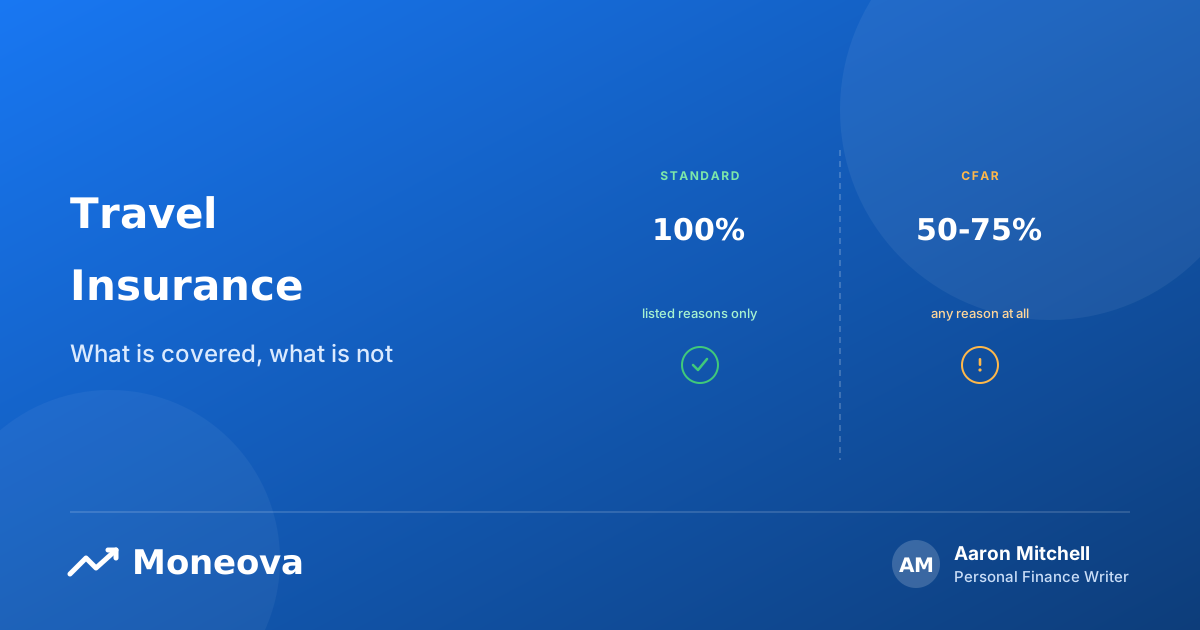
Travel insurance cancellation for any reason, or CFAR, is genuinely different from standard trip cancellation, not just a bigger version of it. Standard cancellation reimburses 100% of trip cost, but only for a specific listed reason. CFAR reimburses a smaller amount, but for literally any reason at all.
- Reimbursement is partial, typically 50-75% of trip cost. This is the trade for the flexibility, not a mistake in the policy.
- Strict purchase window: 14-21 days of your first trip payment. Miss this and CFAR isn't available at any price for that trip.
- You must insure 100% of prepaid, nonrefundable costs, not a partial amount.
- You must cancel at least 48 hours before departure. A same-day cancellation doesn't qualify even with CFAR.
- Real cost: adds roughly 40-60% to the base premium, averaging about 51% based on Forbes' analysis across real plans.
Worked example on a $10,000 trip: a comprehensive plan might run $400-$1,000. Adding CFAR at a 51% average increase adds roughly $200-$500 more, for a total around $600-$1,500. In exchange, cancelling for literally any reason, including simply changing your mind, recovers 50-75% of that $10,000, versus recovering nothing at all without it.
6. Travel Insurance Pre-Existing Condition Waivers: Who Needs One, How It Works
This is where the most expensive misunderstandings happen. For travel insurance with pre existing medical conditions specifically, Squaremouth's guide to pre-existing condition coverage defines a pre-existing condition broadly: anything diagnosed, treated, or even just showing noticeable symptoms before your trip, including symptoms you never got checked out.
Insurers determine this using a "look-back period," typically 60-180 days before your policy purchase date. If your condition was unstable, or you had a medication or treatment change during that window, it generally won't qualify even with a waiver in place.
- Typically covered with a waiver: cancer, diabetes, arthritis, asthma/COPD, heart disease, high blood pressure, past strokes, recent injuries, as long as they were stable and controlled during the look-back window.
- Never covered, even with a waiver: mental health conditions, Alzheimer's/dementia, terminal illnesses, pregnancy, self-harm or substance-abuse-related injuries, elective procedures, and any condition that worsened during the look-back period itself.
To qualify, you generally need to buy within 14-21 days of your first trip deposit, insure the full nonrefundable trip cost, and be medically stable and fit to travel on the day you buy the policy. Family members and travel companions listed on your policy are typically covered by the same waiver too, not just you.
7. Who Actually Needs Which Type of Travel Insurance Coverage
Not every traveler needs the same policy, and matching coverage to trip type is where a lot of money gets wasted in both directions, either underinsuring a real risk or overpaying for protection a specific trip doesn't need.
| Traveler type | Medical coverage | Evacuation | Worth adding |
|---|---|---|---|
| Domestic traveler | $25,000-$50,000 | $100,000 | Travel delay |
| International traveler (travel insurance international) | $100,000-$250,000 | $250,000-$500,000 | Pre-existing waiver |
| Cruise passenger (cruise travel insurance) | $250,000+ | $500,000+ | Missed connection, CFAR |
| Adventure traveler | $250,000+ | $500,000+ | Hazardous sports rider |
| Senior traveler (travel insurance for seniors, 65+) | $100,000+ | $250,000+ | Pre-existing waiver, buy early |
Cruise passengers and adventure travelers need the highest evacuation limits specifically, since medevac insurance from a cruise ship or a remote destination genuinely can run $50,000-$150,000 or more just for the transport itself, before any actual treatment cost.
Domestic travelers, by contrast, are usually adequately covered by their existing health insurance for the medical piece, and mainly need travel insurance for the trip-cost protection, sometimes as a medical only travel insurance add-on rather than a full comprehensive plan.
8. The Schengen Visa Insurance Requirement Most Travelers Don't Know About
This isn't optional guidance. If you're applying for a Schengen visa, travel insurance is a legal requirement to even get the visa approved, not just something worth considering.
Under EU Regulation (EC) No 810/2009, the Schengen Visa Code, your policy must provide at least €30,000 in medical coverage, roughly $35,000, covering emergency treatment, hospitalization, and repatriation. It has to be valid across all 29 Schengen member states, not just the one country you're actually visiting.
The trap that catches people applying at the last minute: some consulates explicitly reject reimbursement-basis policies, where you pay for care upfront and get reimbursed afterward. They want a policy with no deductible and no co-pay structure, sometimes called direct-pay or guaranteed-pay coverage. A perfectly good ordinary travel insurance policy can get a visa application rejected purely because of this structural difference, even with coverage well above the €30,000 minimum.
9. Annual Travel Insurance vs Single-Trip: The Real Break-Even
This is a genuine either-or decision most people never actually run the math on, defaulting to single-trip out of habit even when it costs more over a year.
- Single-trip policies cover exactly one trip, priced against that trip's specific cost and dates. This is the right default for someone traveling once, or rarely.
- Annual, or multi-trip, policies cover every trip you take in a 12-month period, up to a per-trip duration cap, typically 30-70 days. These typically run $200-$500/year for an individual, $400-$900/year for a family.
The real break-even point, consistently cited across the industry, is 3 or more trips per year. Below that, single-trip policies usually cost less in total. At 3 or more, annual coverage typically wins, and it also removes the risk of forgetting to buy coverage before a spontaneous trip, since it's already active.
10. Travel Insurance: Why Price-Value Score Alone Doesn't Tell the Whole Story
The same Forbes Advisor analysis also tracks two separate scores per company: a Price-Value Index (coverage per dollar spent) and a Customer Satisfaction score. Most comparison content only shows the first. The second tells a genuinely different, more useful story.
| Company | Price-Value Index (of 5) | Customer Satisfaction (of 5) |
|---|---|---|
| Travel Insured International | 5 | 4.05 |
| Aegis | 5 | 4.05 |
| HTH Worldwide | 5 | 2.74 |
| Battleface | 5 | 2.41 |
| Tin Leg | 5 | 2.10 |
| IMG | 5 | 0 |
| WorldTrips | 4 | 5.00 |
| Seven Corners | 4 | 0.56 |
| PrimeCover | 3 | 0.67 |
Six different companies all earn the identical top Price-Value score of 5, meaning their coverage-per-dollar is rated equally strong. But their actual customer satisfaction ranges from a perfect-adjacent 4.05 down to 0.
IMG, despite matching the best possible price-value score, has the lowest customer satisfaction on this entire list. Meanwhile WorldTrips, one tier down on price-value, has the single highest satisfaction score of any company measured. A company that's technically the best deal on paper isn't automatically the company people are happiest with after actually filing a claim.
11. What Actually Makes Each Travel Insurance Company Different
Beyond price and coverage limits, each company genuinely specializes differently, and picking based on brand recognition alone misses this.
- Allianz is the largest, most recognized name in the category, with the widest network of customer service infrastructure. Its entry-level OneTrip Basic plan trades that recognition for meaningfully lower medical coverage than competitors at a similar price, so the brand name alone doesn't guarantee the best terms at every tier.
- Seven Corners consistently offers some of the highest medical evacuation limits in the category, up to $1 million on its Trip Protection Choice plan, making it a strong specific fit for remote-destination and adventure travel even though its customer satisfaction score is modest.
- IMG leans toward higher medical coverage ceilings on its top-tier iTravelInsured LX plan, but carries the lowest customer satisfaction score of any major company Forbes tracked, worth weighing against its strong price-value rating.
- Travelex tends to run cheaper at the entry level than most direct competitors, making it a reasonable starting point for budget-conscious comprehensive coverage, though its top-tier Ultimate plan costs meaningfully more once real medical limits are added.
- Travel Guard (AIG) sits at the more expensive end across every tier tested, but backed by AIG's much larger insurance infrastructure, which matters more to some travelers than the headline price.
- World Nomads markets specifically toward adventure and long-term independent travelers, with sports and activity coverage built into its structure rather than added as an afterthought, though its Epic tier runs among the most expensive plans compared here.
12. How to Actually File a Travel Insurance Claim, Step by Step
Understanding what a policy covers doesn't help much if you don't know what to actually do when something goes wrong. This is the practical half most explanations skip entirely.
- Contact your insurer within 24-48 hours. Most policies require prompt notification, and for medical emergencies or evacuation specifically, call the insurer's emergency assistance line immediately, not the general claims line. Acting fast can also mean the insurer coordinates and pays providers directly, rather than you paying out of pocket and waiting for reimbursement.
- Document everything as it happens, not afterward. Photos, itemized receipts, medical reports, and police reports (for theft) all carry more weight collected in real time than reconstructed weeks later from memory.
- For baggage claims specifically, file a Property Irregularity Report with the airline before leaving the airport. This is the single most common, avoidable mistake. Filing it even the next day, rather than at the baggage desk itself, can invalidate the entire claim regardless of how legitimate the loss was.
- Review your Certificate of Insurance for your specific benefit. Confirm the dollar limits, exclusions, and deadline that apply to your specific situation, not the policy in general.
- Submit the complete claim within the deadline, typically 90 days. Some plans allow up to a year, but 90 days is the common default. An incomplete claim missing documentation is the single biggest reason processing stretches out.
- Expect 4-6 weeks for a complete, well-documented claim to process. Missing paperwork is what extends this window, not the insurer being slow by default.
13. Real Travel Insurance Companies Compared
These figures come from Forbes Advisor's own documented rate analysis for two travelers age 40 on a $5,000 trip, cross-checked against each company's own plan descriptions, including Allianz travel insurance and AIG travel insurance among the nine plans compared.
| Company | Plan | Price (2 travelers, age 40) | Medical coverage | Evacuation |
|---|---|---|---|---|
| Allianz | OneTrip Basic | $214 | Lower tier | Up to $1M |
| Allianz | OneTrip Premier | $398 | $75,000 | Up to $1M |
| Seven Corners | Trip Protection Basic | $214 | Moderate | Up to $1M |
| Seven Corners | Trip Protection Choice | $310 | $500,000 | Up to $1M |
| IMG | iTravelInsured Choice | $175 | $100,000 | $500,000 |
| IMG | iTravelInsured LX | $397 | $500,000 | Up to $1M |
| Travel Guard (AIG) | Travel Guard Preferred | $379 | Higher tier | Included |
| Travelex | Essential | $164 | $250,000 | Up to $1M |
| Travelex | Ultimate | $238 | Higher tier | Up to $1M |
Two things stand out here. First, price tier within a single company doesn't move in a straight line with what you'd expect: Allianz's entry-level OneTrip Basic actually has notably lower emergency medical coverage than several competitors' comparably-priced plans, which only shows up once you compare the actual coverage limits, not just the price.
Second, the gap between a company's own cheapest and most comprehensive plan is often larger than the gap between different companies at the same tier, meaning which specific plan you pick usually matters more than which company you pick.
14. Travel Insurance Cancel For Any Reason Costs by Company
CFAR's price premium varies significantly by company, not just by the standard 40-60% rule of thumb.
| Company | Plan | Without CFAR | With CFAR | % increase |
|---|---|---|---|---|
| Allianz | OneTrip Premier | $330 | $440 | 33% |
| Seven Corners | Trip Protection Choice | $198 | $281 | 42% |
| IMG | iTravelInsured Choice | $132 | $199 | 51% |
| Travel Guard (AIG) | Travel Guard Deluxe | $396 | $484 | 22% |
| Trawick International | Pathway Premium | $166 | $251 | 51% |
Travel Guard's 22% increase and Allianz's 33% are both meaningfully cheaper CFAR add-ons than IMG's or Trawick's 51%, on otherwise comparable plans. If CFAR flexibility genuinely matters for a specific trip, this is a real, concrete reason to shop the CFAR premium specifically, not just the base plan price.
15. Age Rules: Is There a Maximum Age for Travel Insurance?
There's no universal cutoff across the industry, but it genuinely varies by company, and by which specific plan tier you pick within a company, more than most people expect.
- Minimum age: 18 to be the policyholder. Children have to be added to an adult's policy; many plans include them at no extra charge under "kids covered free" pricing, though newborns sometimes need to be at least 14 days old.
- Maximum age varies genuinely by company. Travel Insured International, Travelex, and GoReady by Aegis carry no age limit at all. Seven Corners covers travelers up to 99. Some other companies do cap around 79-80, so the specific company matters more than any industry-wide rule.
- The same company can have different caps on different tiers. A comprehensive plan might carry no age limit while that same company's medical-only plan caps out around 69, so checking the specific plan matters, not just the company name.
- Age locks in on the date the policy is issued, not your trip date. If you're 79 when you buy and turn 80 during the trip, most insurers treat you as 79 for the entire policy duration.
16. Travel Insurance State Rules: The Free Look Period Almost Nobody Uses
This is a real, legally-backed consumer protection, not a marketing feature, and it's required by law in the majority of US states.
A free look period, sometimes called a money-back guarantee, gives you a window after purchase to cancel for any reason at all and get a full refund, as long as you haven't started your trip, filed a claim, or used any benefit yet. It typically runs 10-15 days, though the exact length varies by state and by provider, sitting anywhere from 3 to 21 days.
The regulatory backbone here is the NAIC Travel Insurance Model Act, a framework the National Association of Insurance Commissioners built specifically for this, which most states have adopted in some form through their own Department of Insurance. If an insurer refuses a valid free-look cancellation, that's genuinely a regulatory violation a state insurance department can act on, not just a customer service dispute.
Practically, this means buying early and reviewing the actual Certificate of Insurance, not just the marketing page, costs nothing. If the coverage isn't right once you actually read it closely, the free look period is a real, no-penalty way out, not a hypothetical one.
17. A Real Travel Insurance Example: Same Trip, Three Different Outcomes
Maria, David, and Carol are all 45-year-olds taking the same $8,000 international trip, but they made different insurance choices.
| Maria | David | Carol | |
|---|---|---|---|
| Choice | Comprehensive, no CFAR | Comprehensive + CFAR | No insurance |
| Premium paid | ~$340 | ~$510 | $0 |
| What happened | Cancelled 2 weeks before, listed reason (illness) | Cancelled 1 week before, no listed reason (changed plans) | Cancelled 1 week before, no listed reason |
| Outcome | 100% reimbursed, ~$8,000 | 65% reimbursed via CFAR, ~$5,200 | $0 reimbursed |
| Net result | $8,000 recovered, $340 spent | $5,200 recovered, $510 spent | $8,000 lost entirely |
Maria's covered reason meant full reimbursement at the lowest premium. David's reason wasn't on any standard list, so only his CFAR upgrade saved him anything at all, and even then only two-thirds of the trip cost. Carol's decision to skip insurance entirely cost her the full $8,000, more than 15 times what David spent on the most expensive option.
18. Frequently Asked Questions
19. Final Thoughts
Travel insurance isn't a single yes-or-no decision. It's several separate coverages bundled together, each triggered differently, and the right combination depends on your trip type, your age, and your health history more than any single universal recommendation.
Before buying, know your trip cost, know your age bracket's real pricing, and decide early, since both CFAR and the pre-existing condition waiver have strict purchase windows that close fast. Waiting past that window doesn't just cost more, it removes options entirely, regardless of how much you're willing to pay later.
If age-driven insurance costs are on your mind more broadly, our long-term care insurance guide covers a much larger version of the same pattern.
This article is for general information only and is not insurance advice. Coverage details, pricing, and specific company plans cited here were current as of 2 September 2026 and change without notice; confirm current terms, pricing, and eligibility directly with the insurer or a licensed agent before purchasing. Figures in examples are illustrative, not guarantees of any specific outcome or quote.Disclaimer.